Peru is three countries in one: a desert coast, a sky-high Andean spine, and a vast green Amazon. Packing for a single trip that crosses all three requires real thought — the right layers, the right footwear, and the right health kit can make the difference between a comfortable adventure and a preventable misery.
This guide has been updated for 2026, incorporating the most practical advice for visitors travelling to Lima, Cusco, Machu Picchu, the Sacred Valley, Arequipa, Paracas, and the Amazon jungle. Whether you are a first-time visitor packing a checked bag or a digital nomad fitting everything into a carry-on, this list covers what actually matters — and what you can safely leave behind.
🧥 Clothing: Coast, Andes & Jungle
Thermal & Mid Layers
Essential · Andes & High Altitude Destinations
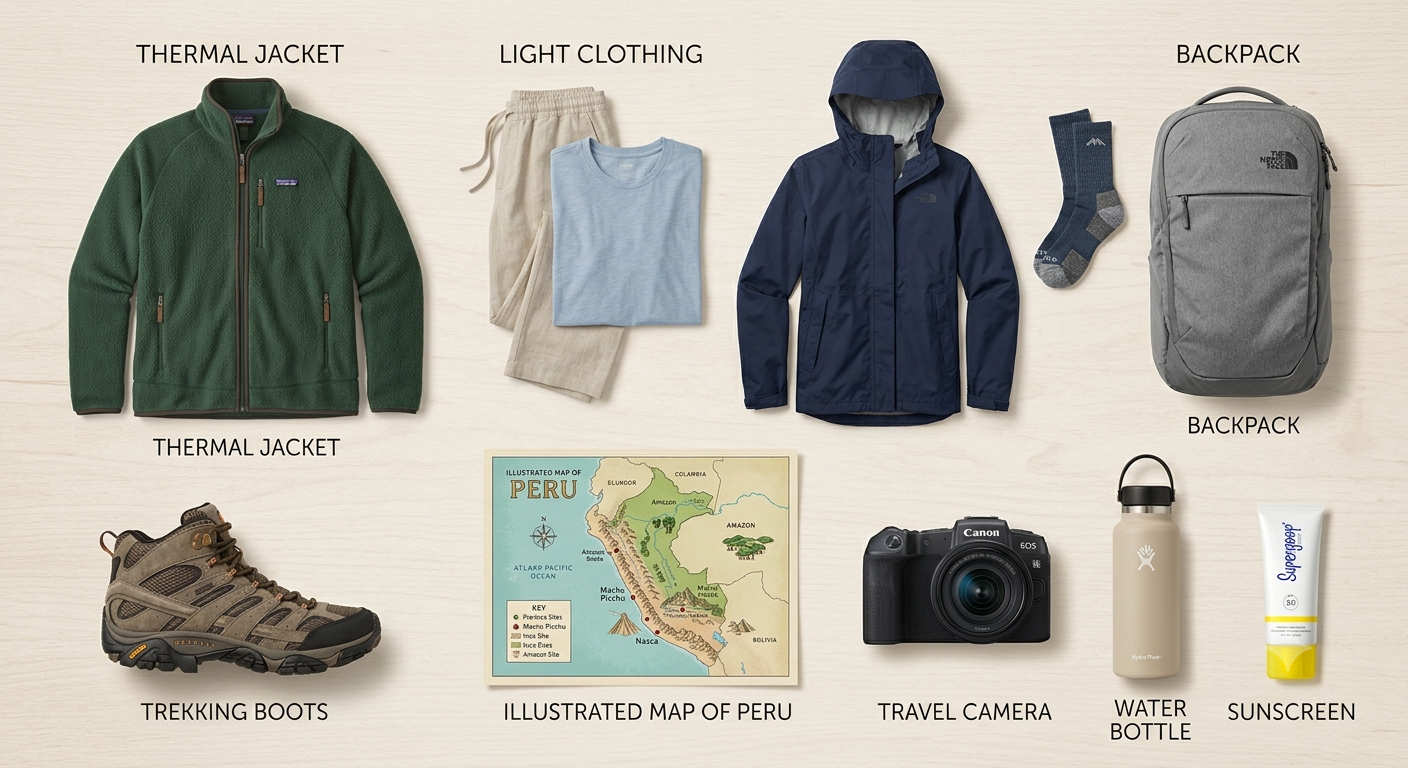
Cusco sits at 3,400 metres above sea level; Machu Picchu at 2,430 metres. Nights in the Andes are cold year-round, and mornings at Machu Picchu — even in the dry season — can be bitterly cold before sunrise. Pack a thermal base layer (merino wool or synthetic), a mid-layer fleece, and a windproof or waterproof outer shell. The layering system allows you to adapt quickly as temperatures shift through the day — Cusco afternoons can reach 18–20°C while mornings begin below 5°C. Avoid packing cotton as your primary layer: it loses insulation when wet and dries slowly at altitude.
Tip: Alpaca knitwear is widely available and affordable in Cusco markets — a high-quality alpaca sweater works excellently as a mid-layer and doubles as a memorable souvenir.
Light Clothing for the Coast & Jungle
Lima · Paracas · Amazon Regions
Lima's coastal climate is mild and often overcast, particularly May to November — light trousers, t-shirts, and a light jacket are enough. For the Amazon jungle (Iquitos, Puerto Maldonado, Manu), pack lightweight, long-sleeved shirts and long trousers in neutral or earth tones. These protect against insects, sun exposure, and branches without causing overheating in the high humidity. Avoid dark colours (attract insects) and bright colours (disturbances to wildlife). Fast-drying synthetics are far preferable to cotton in the jungle. Pack two or three changes of clothing and plan to rinse and dry daily rather than overpacking.
Tip: A lightweight rain poncho is invaluable for the Amazon and for Machu Picchu during the wet season (November to April). They fold small and weigh almost nothing.
👟 Footwear
Trekking Boots & Walking Shoes
Essential for Machu Picchu, Inca Trail & Sacred Valley
Your footwear choice is the single most important gear decision for a Peru trip. Mid-cut waterproof hiking boots with ankle support are essential if you plan to trek the Inca Trail, Salkantay, or Ausangate. They should be well broken in before departure — new boots on the Inca Trail are a recipe for blisters. For lighter sightseeing — Sacred Valley, Cusco city, Lima — comfortable trail runners or supportive walking shoes suffice. For the Amazon, lightweight waterproof boots or rubber boots (often provided by jungle lodges) protect against mud, insects, and water. Consider packing a pair of lightweight sandals for evenings, boat journeys, and hostel use.
Tip: Merino wool trekking socks are worth the investment. They control odour across multiple wears, reduce blistering, and regulate temperature better than standard synthetic socks.
🎒 Travel Gear & Bags
Backpacks & Day Bags
Recommended Capacity: 40–55L Main · 20–25L Day Pack
A 40–55 litre travel backpack is the ideal main bag for Peru. It qualifies as cabin luggage on most airlines, avoids checked baggage fees and delays, and is far more practical than a wheeled suitcase on cobblestone streets, jungle paths, and bus terminals. Choose a pack with a hip belt to transfer weight off your shoulders for long walks. A 20–25 litre day pack is essential for Machu Picchu (mandatory bag size limit) and daily sightseeing. Bring a small dry bag or waterproof cover for boat journeys on Amazon rivers and wet-season trekking. A reusable water bottle with a filter (such as a LifeStraw bottle) reduces plastic waste and saves money in areas where purified water is sold at a premium.
Tip: Machu Picchu enforces a 20-litre maximum bag size at the entrance gate. A standard city backpack works; a large trekking pack will be refused.
💻 Electronics & Adapters
Peru uses 220V / 60Hz electricity with flat two-pin sockets (Type A and Type C). Most modern electronics (laptops, phone chargers, camera chargers) are dual voltage and will work with only an adapter plug. Check your device labels before packing a heavy converter. Essential electronics for Peru: phone with downloaded offline maps (Maps.me or Google Maps offline areas), portable power bank (essential for long treks and jungle days away from power), universal adapter, and a good travel camera if photography is a priority. A waterproof case or dry bag for your phone is strongly recommended for boat journeys and Amazon exploration. Noise-cancelling headphones make overnight buses and long domestic flights significantly more comfortable.
🏥 Health, Safety & Medications
The health kit is where many travellers under-pack. For Peru, include: altitude sickness medication (Acetazolamide / Diamox — consult your doctor; begin dosing 24 hours before ascending to altitude), oral rehydration salts (traveller's diarrhoea is common), broad-spectrum insect repellent with at least 30% DEET for the Amazon and jungle regions, high-SPF sunscreen (UV radiation at altitude is intense — Cusco at 3,400m receives far more UV than sea level), a basic first-aid kit including blister plasters, antihistamine, and ibuprofen, and water purification tablets as a backup. Yellow fever vaccination is required for entry into the Amazon basin; consult your travel health clinic 4–6 weeks before departure.
📄 Documents & Money
Carry your original passport at all times — Peru requires it for hotel check-in, domestic flights, and Machu Picchu entry. Keep digital copies in cloud storage and one physical photocopy stored separately from the original. Bring both a Visa/Mastercard credit card (widely accepted in hotels, restaurants, and tour operators) and sufficient cash in US dollars for exchange into soles on arrival. Dollars are the most widely accepted foreign currency in Peru and offer better exchange rates than euros or pounds at most casas de cambio. Carry small-denomination soles for transport, markets, and tips — vendors rarely have change for large bills. Travel insurance with medical evacuation coverage is not optional for Peru — helicopter evacuations from altitude are not uncommon and are extremely expensive without coverage.
📅 Seasonal Considerations 2026
Peru has two distinct seasons. The dry season (May to October) brings clear skies, cold nights in the Andes, and optimal trekking conditions — this is high season, so book Inca Trail permits and accommodation well in advance. The wet season (November to April) brings afternoon rains to the Andes and Amazon, lush green landscapes, and significantly fewer tourists. Pack a waterproof jacket, rain cover for your bag, and quick-dry clothing if visiting November to March. The Inca Trail closes every February for maintenance. Lima's coast is overcast and mild year-round — its own microclimate entirely different from the rest of the country.
💡 Tips for Digital Nomads & Adventure Travellers
For digital nomads staying in Peru for weeks or months: a lightweight laptop, portable SSD for backup, and a reliable eSIM are your core working tools. Co-working spaces are well established in Miraflores (Lima) and Barranco; Cusco has several good options in the San Blas area. For adventure travellers heading into multi-day treks: trekking poles are worth their weight on steep descents, a lightweight sleeping bag liner adds warmth for cold Andean nights in tented camps, and a headtorch with spare batteries is indispensable. Pack your main bag to 80% capacity before leaving home — you will inevitably buy textiles, ceramics, or food products in Peru that need room on the return journey.
📖 COOKBOOK · DIGITAL EDITION
Authentic Peruvian Cuisine
45 authentic recipes from Peru's Pacific coast kitchens — instant PDF download.
Download the Cookbook — $12 →📱 STAY CONNECTED
Peru eSIM — Airalo
Data coverage across Peru from day one. No roaming fees, instant activation.
Exclusive Offer: Save 15% with code PERULOCAL
Get Your eSIM →