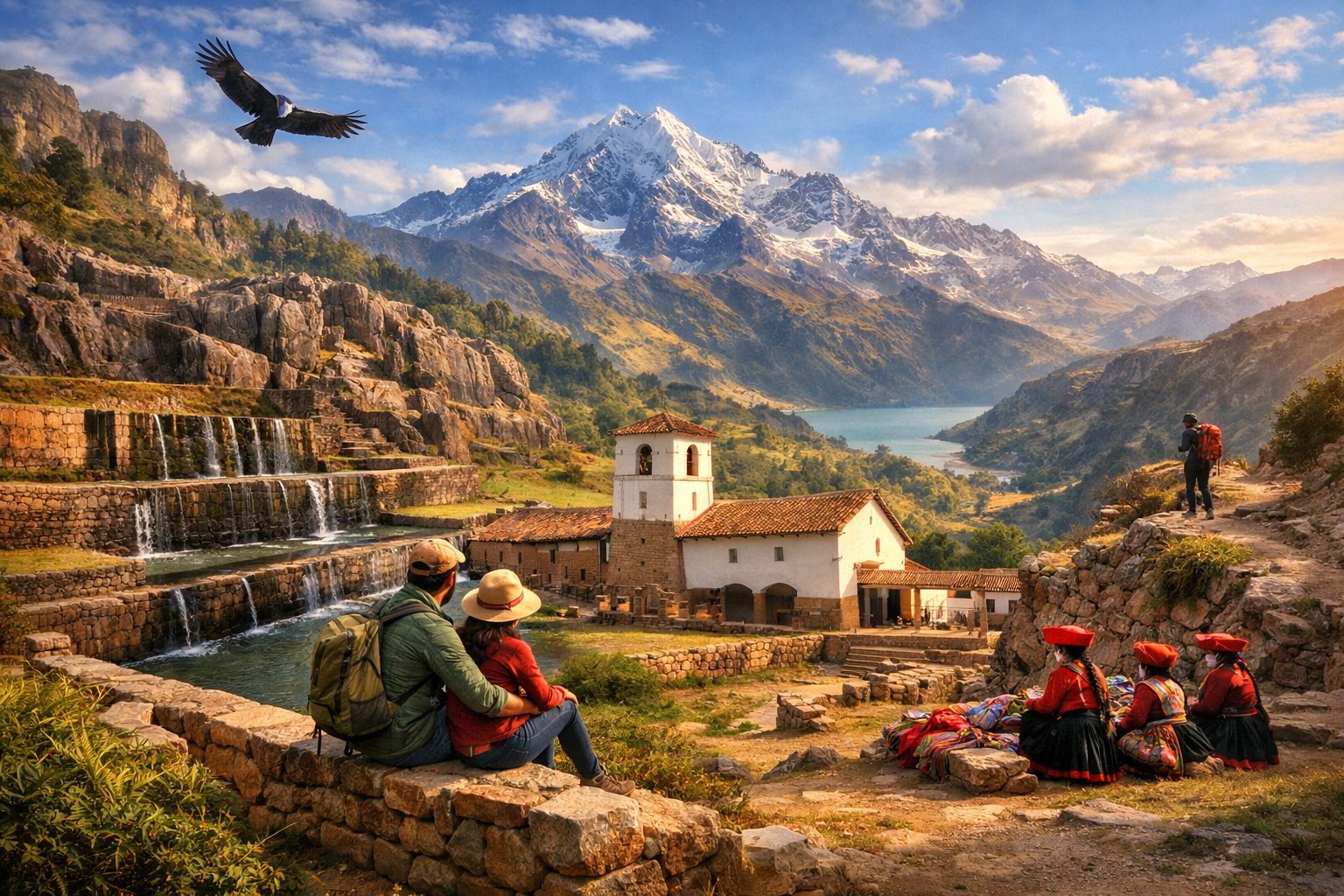
The Sacred Valley of the Incas is one of the most breathtaking corridors in the world — a wide Andean valley carved by the Urubamba River, where ancient Inca ruins, traditional markets, and snow-capped peaks form a landscape unlike anywhere else on earth.
Running northwest from Cusco to Ollantaytambo, the Sacred Valley sits between 2,800 and 3,500 metres above sea level — noticeably lower than Cusco, which makes it an excellent place to acclimatise before heading higher. Most travellers spend one to two days here before continuing to Machu Picchu by train from Ollantaytambo.
🏛️ What to See
Pisac
Inca Ruins · Sunday Market · Colonial Town
Pisac is the natural starting point for any Sacred Valley visit. The Pisac Inca ruins crown a dramatic ridge above the valley, with terraces, temples, and a solar observatory offering sweeping views in every direction. Below in the town, the Pisac Market — most vibrant on Sundays, Tuesdays, and Thursdays — is one of the Andes' finest artisan markets, with handwoven textiles, ceramics, and silver jewellery made by local Quechua communities. The market has existed in some form for centuries and remains primarily a local trading space, not a tourist trap.
Tip: Take a taxi to the ruins first (morning light is best), then walk down through the terraces to the market. Allow a full morning.
Ollantaytambo
Inca Fortress · Living Inca Town · Train Station for Machu Picchu
Ollantaytambo is the most complete living Inca town in existence — its street grid, water channels, and stone buildings have been continuously inhabited since the 15th century. The Ollantaytambo Fortress is one of the best-preserved Inca sites in Peru: massive terraces rise above the town to a partially completed Temple of the Sun, featuring monolithic pink granite blocks quarried from the mountain directly across the valley. The views from the upper terraces are extraordinary. Ollantaytambo is also the departure point for trains to Aguas Calientes (Machu Picchu Pueblo) — many travellers sleep here the night before an early Machu Picchu visit.
Tip: Arrive in the late afternoon when day-trippers have left. The fortress at dusk, with the valley below, is unforgettable.
Chinchero
Textile Village · Inca Walls · Highland Weaving
Chinchero sits at 3,762 metres above sea level — the highest point of the Sacred Valley circuit — on a broad plateau with panoramic views of snow-capped Andes peaks. The village is famous for its living textile tradition: local women in traditional dress demonstrate the full process of natural dyeing and hand-weaving using techniques passed down over generations. The Chinchero market (Sunday) is more authentic than Pisac's, with fewer tourists and more local trading. The colonial church, built directly over Inca walls and foundation stones, is a striking example of how the Spanish superimposed their culture on Andean civilisation.
Tip: Chinchero is best visited en route between Cusco and Pisac, not as a standalone trip. Most Sacred Valley tours include it.
Moray & Maras Salt Ponds
Inca Agricultural Lab · Pre-Inca Salt Works
The Moray circular terraces are one of the most visually stunning and intellectually intriguing Inca sites in Peru. Three concentric bowl-shaped depressions, lined with agricultural terraces, were used by the Inca as experimental growing stations — each level maintains a different microclimate, allowing them to cultivate crops from different altitudes in a single location. Just 5 km away, the Maras salt ponds have been worked continuously since pre-Inca times. Over 3,000 individual pools cascade down the hillside, fed by a single underground saltwater spring, their white and pink surfaces gleaming against the Andean backdrop. Both sites can be visited in a single afternoon by taxi or bicycle from Urubamba.
Tip: Rent a bicycle in Urubamba and cycle to Moray and Maras. The route is spectacular and mostly flat between sites.
🗺️ Suggested Itinerary
Day 1 — Valley Circuit: Depart Cusco early by taxi or tour bus. Start at Chinchero (market + church + textiles). Continue to Moray and Maras salt ponds in the early afternoon. Overnight in Urubamba or Ollantaytambo.
Day 2 — Ruins & Market: Morning at Pisac ruins (arrive before 9 AM to beat the crowds). Walk down to the Pisac market. Afternoon transfer to Ollantaytambo — explore the fortress and the town's Inca streets. Board the evening train to Aguas Calientes for Machu Picchu the next morning, or return to Cusco.
🚌 Getting Around
The Sacred Valley is approximately 40 km northwest of Cusco. The most flexible option is a hired taxi or private car from Cusco — agree on an all-day rate including stops (approximately USD 40–60). Collectivos (shared minibuses) run frequently from Cusco's Terminal Terrestre to Pisac and Urubamba, but schedule changes mean they're not reliable for tight itineraries. Organised day tours (see the sidebar) are the most efficient way to see multiple sites without logistical stress. The train to Machu Picchu departs from Ollantaytambo — book Peru Rail or Inca Rail tickets well in advance, particularly April through October.
🛡️ Safety Tips
The Sacred Valley is one of the safest regions in Peru for tourists. The main risks are altitude-related — Chinchero sits at nearly 3,800 metres, and even visitors acclimatised to Cusco may feel the elevation. Take it slowly, drink water, and avoid strenuous activity on arrival. Market areas in Pisac can attract pickpockets in peak season — keep your bag in front of you and don't carry more cash than you need. Verify any taxi or tour before departure and agree on all prices upfront. The valley road between Pisac and Ollantaytambo is well-maintained but has sharp bends; reputable drivers are cautious.
🏡 Where to Stay
The Sacred Valley has accommodation options at every level, and staying in the valley — rather than Cusco — allows you to experience the Andes at a gentler altitude and in a far more peaceful setting. Urubamba is the valley's main hub, with the widest range of hotels and the most central location. Ollantaytambo is the best base for an early Machu Picchu train. The valley hosts some of Peru's finest luxury lodges — including the Explora Valle Sagrado and Sol y Luna — as well as solid mid-range options throughout. Use the Hotel Area Check if you're uncertain about any specific location in the valley.
💡 Practical Advice
Best time to visit: May to October is the dry season — clear skies, excellent visibility, cold nights. June and July see the highest visitor numbers. November to April is wetter but offers lush green landscapes and fewer crowds.
Altitude: The Sacred Valley averages 2,800–3,200 metres — lower than Cusco (3,400m) and significantly lower than Chinchero (3,762m). Most visitors acclimatise more comfortably in the valley than in Cusco itself. Coca tea is widely available and helps with mild altitude symptoms.
Currency: Carry soles in cash for markets, entry fees, and smaller restaurants. Card acceptance is limited outside hotels. The Boleto Turístico covers some Sacred Valley sites — check what's included before buying separate tickets.
Language: Quechua is widely spoken alongside Spanish in the valley. A few words — "Allillanchu" (hello), "Sulpayki" (thank you) — are always appreciated by local communities.
🎁 FREE — INSTANT DOWNLOAD
Peru Safety & Scam Guide
Essential local advice for every traveller to Peru — common scams, taxi safety, altitude sickness, and what to avoid in every major destination. Free PDF, no email required.
Download Free PDF →📖 DIGITAL COOKBOOK
Peruvian Coastal Cuisine
45 authentic recipes from Peru's Pacific coast kitchens — instant PDF download.
Download Now · $12 →🏔️ Sacred Valley – Recommended Tours
The following tours are verified and bookable directly. No prices are shown — rates vary by season and availability. All include transport from Cusco.
Sacred Valley Tour in Cusco
11 hours
A comprehensive full-day guided tour of the Sacred Valley, covering all major Inca sites and cultural highlights with an experienced local guide. Includes transport from Cusco.
Check Price →Sacred Valley Full Day – Small Group
8–10 hours
Full-day small group tour visiting Pisac, Ollantaytambo and Chinchero. Smaller groups allow for a more personalised experience and greater flexibility at each site.
Check Price →Sacred Valley & Moray Salt Mines
11–12 hours
Extends the classic Sacred Valley circuit to include the Inca experimental terraces at Moray and the ancient Maras salt ponds — two of the most visually striking sites in the Cusco region.
Check Price →Physical SIM vs eSIM: Buying a physical SIM in Peru often means long queues at the airport or shopping centres, and you will need to show your passport for registration. To skip the wait and arrive already connected, activating an Airalo eSIM before your flight is the smarter alternative. Use code PERULOCAL for an exclusive 15% discount — and step off the plane with data already running.
✈️ Travel Tip: Save on Roaming Costs in Peru
Travelers can avoid expensive roaming fees by using Airalo eSIMs, the world's first eSIM store with fast, reliable data plans for Peru and 200+ destinations.
Exclusive Offer: Save 15% on your first eSIM with the code PERULOCAL.
Set up your Airalo eSIM before flying and stay connected the moment you land. Buy Your eSIM
Ready to travel smarter? Get Your eSIM Now
Offer valid until December 31, 2026.