
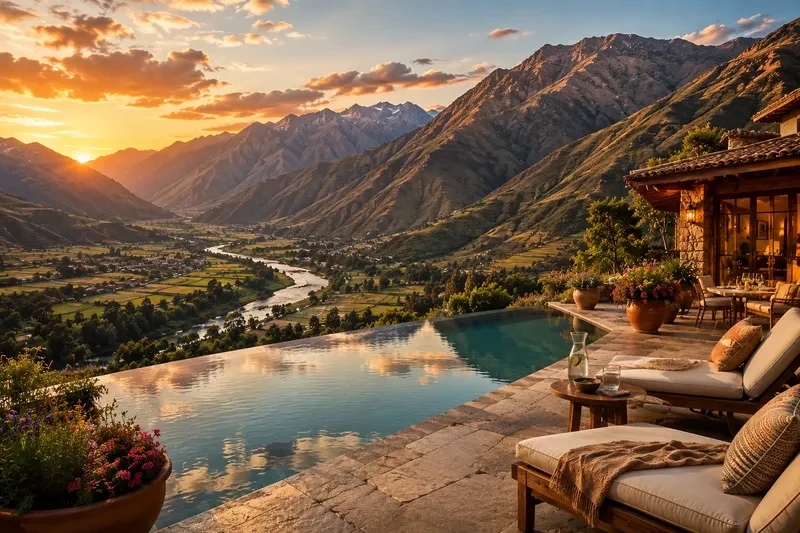
Between Cusco and Machu Picchu lies a valley that asks nothing of its visitors except time — and rewards it more generously than almost anywhere else in Peru.
The Sacred Valley — Valle Sagrado to Peruvians, following the Urubamba River as it cuts north from Pisac through Ollantaytambo toward the mountains that guard Machu Picchu — has spent the last decade quietly becoming the Andes' most sophisticated address. Its terraced fields and salt-white cliffs have always been extraordinary; what's changed is the caliber of hotel now built into them, and the growing number of travelers who realize the valley deserves days, not hours. This guide is built around three practical questions: where to base yourself, which hotels are actually worth the altitude adjustment, and how to spend your days once you've arrived.
It helps to think of the valley less as a single destination and more as a loose string of market towns and archaeological sites, each with its own character, connected by a single scenic road that follows the river for roughly 60 kilometres. Some travelers base themselves in one town and take day trips outward; others move through the valley over several nights, sleeping somewhere different every one or two days. Both approaches work — what matters is choosing a pace deliberately, rather than defaulting to the rushed half-day version most large group tours offer.
What follows draws on the same editorial standard as the rest of our Peru Luxury Guide coverage: no invented superlatives, no generic "hidden gem" language, and a clear distinction between what's genuinely exceptional and what's merely convenient. Where we reference specific hotels or tours, they're properties and operators we'd recommend to a well-traveled friend without hesitation.
Why the Sacred Valley Rewards Slowing Down
Most first-time visitors treat the Sacred Valley as a corridor — a scenic drive between Cusco and the Machu Picchu train, seen from a bus window on the way to somewhere else. That's a genuine loss. At 2,800 to 2,900 metres, the valley floor sits nearly 500 metres below Cusco's own 3,400-metre elevation, which means most travelers acclimatize here more comfortably than in the city itself. The result is a rare kind of Andean destination: dramatically scenic, culturally dense, and physically gentler than its more famous neighbors.
The valley's Inca history is not curated for tourists so much as lived alongside them. Terraces still under cultivation climb the hillsides at Pisac and Moray. Ollantaytambo's fortress town is one of the only places in Peru where the Inca street grid remains genuinely intact, with families still living behind the same stone walls their ancestors built. Chinchero's Sunday market trades in the same wool and dye techniques practiced for centuries. Luxury travel here means positioning yourself to experience that continuity properly — with a comfortable base, a good driver or guide, and enough time to let each place unfold rather than rushing to the next.
There's also a practical case for the valley beyond scenery and altitude. Agriculture here operates at genuinely different microclimates within a few kilometres of each other — the same principle Moray's terraces were likely built to study — which means the valley produces an unusually wide range of ingredients for its size: corn varieties found nowhere else, native potatoes by the hundred, herbs that show up on tasting menus across Lima and Cusco. Several of the valley's hotels and restaurants lean directly into this, sourcing much of what lands on the table from within walking distance of the kitchen.
Best Areas to Base Yourself
The Sacred Valley is roughly 60 kilometres long, and where you choose to stay shapes the whole visit — proximity to Cusco, distance to the Machu Picchu train, and the character of each town all vary considerably along its length.
Urubamba — The Valley's Practical Heart
Urubamba sits near the valley's midpoint and has become its default luxury hub, home to the majority of the valley's finest hotels, including Tambo del Inka and Sol y Luna. It's a working town rather than a curated one — real markets, real traffic, a real Plaza de Armas — which gives it an authenticity some of the valley's smaller villages have traded away. Its central position makes it a genuinely efficient base for day trips to Moray, Maras, Pisac, and Ollantaytambo alike.
Beyond logistics, Urubamba rewards travelers willing to explore its own immediate surroundings — the town's outskirts open quickly onto working farmland, and several of the valley's best restaurants sit within a short drive, drawing on the same agricultural richness that makes the area so fertile. For travelers building a longer stay, it's also the most practical base for arranging a private driver for the full length of the valley, since most operators are headquartered here or in Cusco.
Ollantaytambo — Living Inca Architecture
The only town in the Sacred Valley where you can sleep inside an intact Inca urban plan, Ollantaytambo is also the valley's most strategically useful base for anyone taking an early Machu Picchu train, since the station sits right in town. Its fortress — a monumental terraced complex rising directly above the plaza — rivals Machu Picchu itself for sheer stonework, without requiring a single tour bus to reach it.
The town itself is worth a slow evening walk: narrow stone canals still channel water through the streets exactly as they did five centuries ago, and several of the original Inca canchas — walled residential compounds — remain inhabited today rather than roped off as ruins. Ollantaytambo tends to have a smaller, more intimate hotel scene than Urubamba, which suits travelers who'd rather explore on foot than drive between sights.
Pisac — Market Town With Serious Ruins
Pisac pairs one of Peru's most photographed artisan markets with a genuinely significant Inca archaeological site on the ridge above town — agricultural terraces, ceremonial platforms, and one of the largest pre-Columbian cemeteries in the Americas, largely uncrowded outside peak market days. It sits closest to Cusco of any Sacred Valley town, making it a natural first or last stop.
Market days (traditionally Sunday, though smaller versions now run most days) draw understandably large crowds by mid-morning; arriving early, or timing a visit for the archaeological site first and the market for lunch, avoids the worst of it. The surrounding hillsides also offer some of the valley's better short hikes, with views back down over the terracing that rival anything at Moray.
Chinchero — Weaving Villages and Mountain Views
Higher and quieter than the valley floor, Chinchero is where Andean textile traditions are most visibly alive — women's cooperatives still dye wool with cochineal and local plants using techniques unchanged for generations. Its colonial church, built directly atop an Inca temple's foundations, and its own set of ruins make it a worthwhile stop even for travelers based elsewhere in the valley.
Sitting at roughly 3,760 metres — noticeably higher than the valley floor towns — Chinchero is less commonly used as an overnight base and more often visited as a half-day stop en route between Cusco and Urubamba, which works well given its relatively short list of accommodation compared to Urubamba or Ollantaytambo.
Yucay & the River Corridor — Quiet and Residential
Just outside Urubamba, the smaller village of Yucay and the surrounding riverside corridor offer a noticeably quieter alternative — several of the valley's more secluded luxury lodges, including Rio Sagrado, sit along this stretch, trading a few minutes' extra drive for genuine seclusion.
This corridor is best suited to travelers who've already spent time in Cusco's busier streets and want the Sacred Valley portion of their trip to feel like a genuine retreat — gardens, river sounds, and long dinners rather than another town center to explore. It's an easy short drive into Urubamba proper whenever a market visit or restaurant booking calls for it.
The Sacred Valley's Finest Hotels
We cover these in full depth — exact locations, rooms, dining, spa facilities and honest pros and cons — in our dedicated Best Luxury Hotels in the Sacred Valley guide. In brief, five properties define the valley's upper tier, each with a distinct personality worth matching to your own priorities.
Tambo del Inka, a Luxury Collection Resort & Spa is the valley's most complete resort — riverside in Urubamba, with an extensive spa built around thermal circuits and Inca-ingredient treatments, multiple dining venues, and a genuinely rare advantage: its own private train platform, letting guests board directly for Machu Picchu without transferring elsewhere. It's the strongest choice for travelers who want full resort amenities without sacrificing convenience.
Rio Sagrado, A Belmond Hotel takes the opposite approach entirely: a secluded, garden-immersed retreat along the river outside Urubamba, where resident alpacas graze the lawns and the pace is deliberately unhurried. It suits couples and honeymooners more than families, and travelers who'd rather spend an evening reading by the river than crossing another amenity off a list.
Sol y Luna, Relais & Châteaux offers individually designed casitas scattered across gardens and orchards, alongside its own Peruvian Paso horse ranch and a foundation supporting a local school — the valley's most culturally rooted luxury stay, and arguably its most distinctive architecturally, since no two casitas are quite alike.
Inkaterra Hacienda Urubamba commits fully to sustainable, farm-to-table luxury on a working organic property between Urubamba and Ollantaytambo, growing much of its own produce and building excursions — birdwatching, farm walks, stargazing — directly into the stay. It's the natural choice for travelers who want genuine sustainability credentials, not just the marketing language of it.
Casa Andina Premium Valle Sagrado delivers comfortable four-star value with a genuinely unusual amenity: its own planetarium, taking advantage of the valley's exceptionally clear night skies. It's the most accessible of the five on price without giving up real comfort, making it a strong fit for families or travelers prioritizing value within an otherwise high-end trip.
Which of the five is "best" depends entirely on what you're optimizing for — logistics and amenity range point toward Tambo del Inka, seclusion toward Rio Sagrado, cultural depth toward Sol y Luna, sustainability toward Inkaterra, and value toward Casa Andina Premium. Our full hotel guide walks through the comparison in more detail, including exact drive times from Cusco Airport for each.
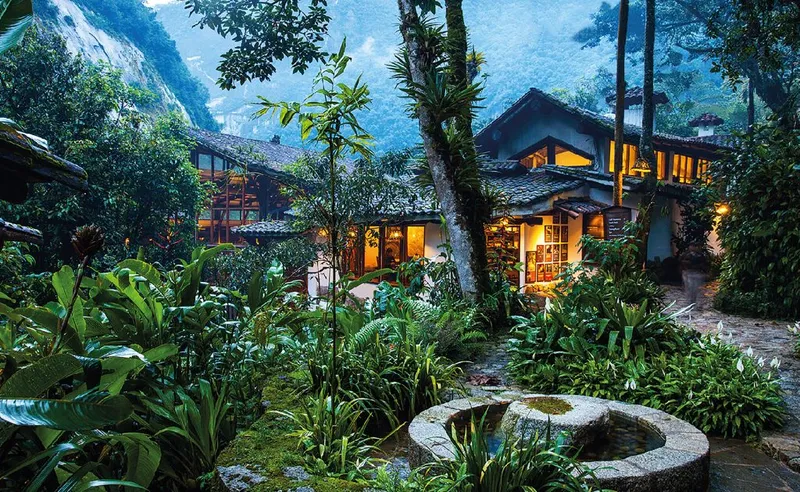
Stay Where the Cloud Forest Meets Luxury
Wander orchid gardens with over 370 native species at the Inkaterra Machu Picchu Pueblo Hotel, unwind at the UNU Spa and visit its Andean spectacled bear rescue program. Published with official authorization of Inkaterra.
Scenic Routes & Signature Experiences
The valley's landscape isn't just a backdrop for its towns — several of its most memorable sights are destinations in their own right, best experienced with a private driver or a well-chosen guided tour rather than rushed between other stops.
Maras & Moray
Two of the valley's most photographed sites sit within a short drive of each other on the plateau above Urubamba. Moray's concentric circular terraces, likely an Inca agricultural laboratory for testing crops at different microclimates, remain one of the more mysterious ancient sites in the Americas — each descending ring can differ in temperature from the one above it by several degrees, a detail that still isn't fully explained. Nearby, the Maras salt ponds — thousands of small terraced pools fed by a saline spring, still worked by local families using pre-Inca techniques — turn a blinding white against the surrounding green terraces, and remain a working, income-generating site rather than a preserved relic. Both are covered in full on our curated Sacred Valley + Maras & Moray day tour, alongside Pisac's market and ruins.
The Ollantaytambo Fortress
Rising in steep terraces directly above Ollantaytambo's plaza, the fortress was one of the few places the Inca successfully repelled a Spanish assault, and its scale — massive fitted stone blocks hauled from a quarry on the opposite mountainside, some weighing several tons — rewards an unhurried visit rather than a quick photo stop. Climbing to the top offers one of the valley's best panoramic views back down over the town's original grid, and the site is rarely as crowded by mid-afternoon as it is at midday.
Chinchero's Market and Weaving Cooperatives
Sunday's market is the best-known draw, but Chinchero's textile cooperatives operate daily, offering genuine demonstrations of natural dyeing and backstrap-loom weaving rather than staged performances — a worthwhile detour even outside market days, and one of the more direct ways to support Andean artisan communities financially.
The Train to Machu Picchu
However you continue on from the valley, the train itself is part of the experience — panoramic windows tracing the Urubamba River gorge as it narrows toward the cloud forest, a journey that several operators have turned into a genuinely elevated experience in its own right, with glass-domed observation cars and full dining service. For travelers who want the valley's ruins, market towns, and the train journey combined into a single well-paced itinerary, our curated tours below cover exactly that ground.
Dining in the Sacred Valley
The valley's kitchens draw on exactly the agricultural range that makes the region agriculturally unique, and several restaurants here now rank among Peru's most interesting outside Lima. MIL, set at 3,573 metres directly above the Moray terraces, runs an avant-garde tasting menu built entirely around Andean ingredients rarely seen on any other menu in the country — reservations are genuinely necessary, often weeks ahead. Closer to Urubamba, SUNO and Alqa both offer contemporary Andean fine dining in more accessible settings, while Hacienda Huayoccari serves a traditional lunch inside a centuries-old working hacienda surrounded by colonial art and farmland. In Ollantaytambo itself, El Albergue — set right at the train station — pairs farm-to-table Peruvian cooking with the valley's most convenient location for a pre-departure meal.
How to Get Around
Most visitors arrive via Cusco's Alejandro Velasco Astete Airport, roughly an hour to an hour and a half by road to most valley towns depending on your final destination. A private driver for the day — easily arranged through any valley hotel — remains the most flexible way to move between Urubamba, Pisac, Moray, Maras, and Ollantaytambo, particularly given how much each site rewards unhurried time rather than a fixed group-tour schedule. Shared vans and colectivos run between the larger towns, though timing can be inconsistent for travelers on a tighter schedule. If continuing to Machu Picchu, trains depart from Ollantaytambo's station, making it worth timing your final valley night there regardless of where you've stayed for the rest of the trip.
When to Visit
The dry season, May through September, offers the most reliable weather and the clearest mountain light for photography, though it's also the valley's busiest period — book hotels and any Machu Picchu train tickets well ahead. The shoulder months of April and October often deliver a strong balance of good weather and thinner crowds. The wetter season from November through March brings dramatically greener terraces and noticeably quieter ruins, at the cost of afternoon rain that's usually brief but predictable enough to plan around. Temperatures vary less by season than by time of day — expect a wide swing between a cold, clear morning and a warm early afternoon, regardless of month.
Who Should Base Here
The Sacred Valley suits almost every kind of traveler well, but it particularly rewards honeymooners and couples drawn to its quieter pace, travelers prioritizing comfortable acclimatization before or after Cusco's higher altitude, and anyone who wants meaningful time with Inca architecture and living Andean culture rather than a single rushed day trip. It's an especially strong fit for travelers taking an early Machu Picchu train, since basing in or near Ollantaytambo can shave real time off departure-day logistics. Families traveling with children tend to do particularly well here too — the lower altitude is genuinely easier on younger travelers than Cusco itself, and several hotels build in horseback riding, farm visits, or gentle hiking that work well across a wide age range.
A Sample Three-Day Sacred Valley Stay
For travelers wondering how to actually sequence a visit rather than simply which sites to see, a three-night stay divided between two bases tends to work better than trying to see everything from a single hotel.
Day one is best spent settling into a hotel in or near Urubamba and acclimatizing gently — a short walk through town, lunch at one of the valley's farm-to-table restaurants, and an early night rather than a packed first-day itinerary. Day two is the natural day for Moray and the Maras salt ponds, ideally in the morning before the light flattens and the crowds thicken, followed by an afternoon in Urubamba's own market or a spa treatment back at the hotel. Day three suits a full day covering Pisac's ruins and market on the way toward Ollantaytambo, where an evening spent walking the original Inca streets — and, ideally, a hotel change to be close to the train station — sets up a smooth departure the following morning, whether that's onward to Machu Picchu or back to Cusco.
Travelers with a fourth or fifth night to spare might add Chinchero as a half-day stop on the way back toward Cusco, or build in a full rest day with no fixed itinerary at all — several of the valley's hotels are genuinely worth an unstructured day on their own grounds.
Altitude, Wellness & Pacing
One of the valley's quieter advantages is how much easier it is on the body than Cusco. At 2,800 to 2,900 metres versus Cusco's 3,400, most travelers notice a real difference in how quickly they adjust, which is why many itineraries now route through the Sacred Valley first and save Cusco — or the even higher Rainbow Mountain and Puno regions — for later in the trip, once partially acclimatized. That said, the jump from sea level is still significant on arrival; hydration, a light first day, and moderating alcohol for the first 24 to 48 hours all make a genuine difference.
Several of the valley's hotels have built wellness directly into their offering rather than treating it as an afterthought — thermal circuits and Inca-ingredient treatments at Tambo del Inka's spa, yoga and a heated pool set in the gardens at Rio Sagrado, guided walks and stargazing at Inkaterra Hacienda Urubamba. For travelers arriving directly from a long-haul flight, building a full rest day into the itinerary before any serious hiking or high-altitude sightseeing is worth the schedule trade-off.
Shopping & Artisan Crafts
Beyond Pisac and Chinchero's markets, the valley supports a genuine artisan economy worth engaging with directly rather than through a single tour-bus market stop. Alpaca and llama wool textiles remain the region's signature craft, and prices vary enormously depending on fiber quality — genuine baby alpaca is soft, slightly warm to the touch, and considerably more expensive than the acrylic blends sold at the busiest market stalls. Several cooperatives around Chinchero and in smaller villages along the valley welcome visitors to watch the full process, from washing and spinning through natural dyeing with cochineal, indigo and local plants, to weaving on traditional backstrap looms. Buying directly from these cooperatives, rather than intermediary shops, puts considerably more of the sale price back into the hands of the weavers themselves.
Getting There from Lima
Most journeys to the Sacred Valley begin with a flight into Lima, followed by a short connecting flight to Cusco before the overland drive into the valley itself. Travelers building a longer Peru itinerary around this trip — pairing the valley with Lima's own restaurant scene, or continuing on to Arequipa and Lake Titicaca — will find our AI Trip Planner useful for working out a realistic day-by-day sequence, and our Cusco Travel Guide covers the city side of that same routing in detail.
Frequently Asked Questions
How many nights should I spend in the Sacred Valley?
Two to three nights lets you cover the main towns and sites without rushing; four or more suits travelers who want to add a cooking class, a horseback outing, or simply more unstructured time.
Should I stay in the Sacred Valley or in Cusco?
Many travelers do both. The valley offers lower altitude, quieter surroundings and closer access to its own sites; Cusco offers colonial architecture, restaurants and nightlife concentrated in a walkable center. Splitting your stay across a few nights in each is a common and effective approach.
Is the Sacred Valley suitable for a honeymoon?
Yes — the combination of scenery, seclusion at properties like Rio Sagrado and Sol y Luna, and a genuinely romantic pace makes it one of Peru's strongest honeymoon settings.
Which town should I stay in if I have an early Machu Picchu train?
Ollantaytambo, whose station serves most valley departures — basing there for your final night removes an early morning transfer from an already early start.
Do I need a private guide, or are group tours sufficient?
Both work, but a private guide or driver gives far more control over pacing at sites like Moray, Maras and the Ollantaytambo fortress, all of which reward unhurried time more than a fixed group schedule allows.
Plan Your Sacred Valley Stay
Whether you're choosing between Urubamba and Ollantaytambo, deciding how many nights the valley deserves within a wider Peru itinerary, or comparing its finest hotels side by side, our free AI Trip Planner can sequence the whole trip in under a minute, and our Best Luxury Hotels in the Sacred Valley guide covers every property in full detail. For the wider luxury picture across Peru, return to the Peru Luxury Guide.