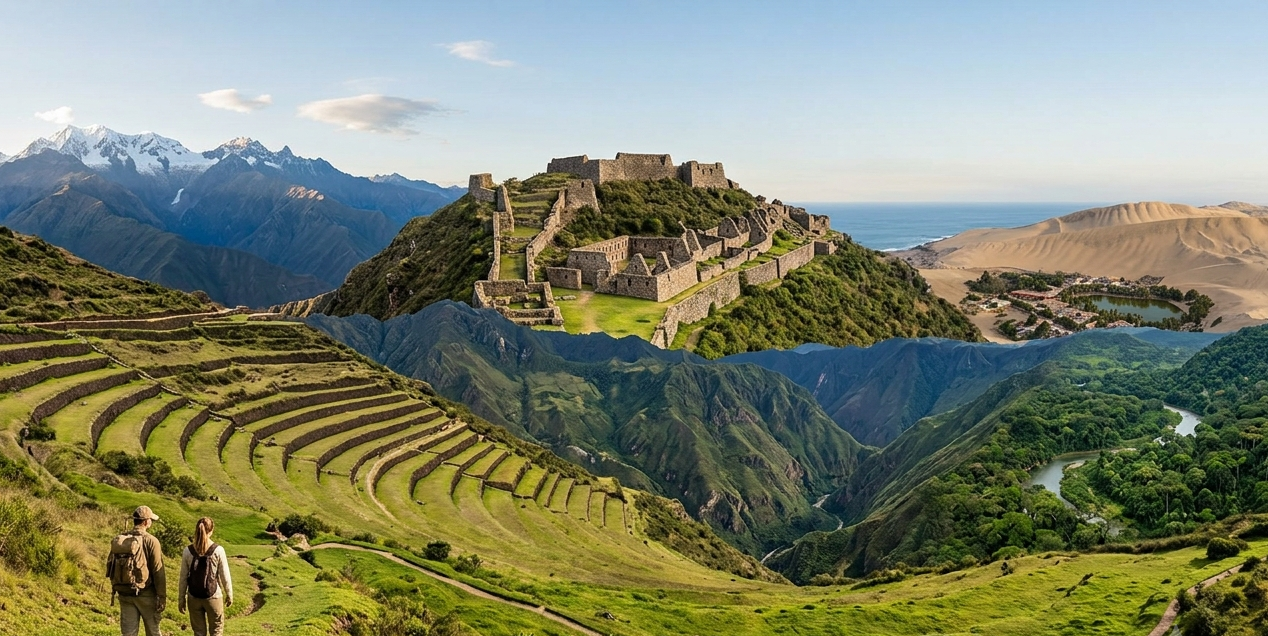
Three weeks is the ideal amount of time to experience Peru's full range — Pacific coast, high Andes, cloud forest, and Amazon basin — without rushing any destination. This 21-day itinerary is designed as a complete loop departing and returning to Lima, covering the country's essential highlights in a logical, transport-efficient sequence.
Peru rewards travellers who slow down, and 21 days gives you that luxury. You will have time to acclimatise properly in Cusco before heading to Machu Picchu, spend more than a single afternoon in Arequipa, and choose between the coloured mountains or a jungle excursion at the end of your Andean section. This guide includes day-by-day structure, recommended transport between each destination, approximate budget, and practical tips on booking, safety, and what to pack.
🗓️ Itinerary Overview
The route follows a clockwise arc from Lima down the Pacific coast, cuts inland to Arequipa and the Colca Canyon, rises to Cusco and the Sacred Valley, visits Machu Picchu, and then continues to Puno on Lake Titicaca before returning to Lima — with an optional Amazon extension in Puerto Maldonado. The logic of this sequence is that it matches the natural transport corridors and avoids unnecessary backtracking.
Days 1–3: Lima
Gateway · Pacific Coast · 0 m altitude
Arrive in Lima and use your first day to recover from the flight and orient yourself. Stay in Miraflores or Barranco — both are safe, well-served by restaurants, and close to the Malecón clifftop walk above the Pacific. On day two, explore the historic centre (Plaza Mayor, the Cathedral, and the catacombs of San Francisco) — a half-day tour covers the essentials efficiently. Dedicate an afternoon to Lima's extraordinary food scene: the city is South America's culinary capital, and ceviche here sets a standard that no other place in Peru quite matches. Day three is for the Larco Museum (pre-Columbian gold and ceramics) and final preparations before your departure south.
Tip: Book the Lima historic centre and catacombs tour in advance — small group tours fill quickly and provide far better context than self-guided visits.
Days 4–5: Paracas & Huacachina
Pacific Reserve · Desert Oasis · 3.5–4 hrs from Lima
Take a morning bus from Lima to Paracas (approximately 3.5 hours, Cruz del Sur or Oltursa recommended). Paracas is a small fishing town on the edge of a stunning marine national reserve — afternoon boat tours visit the Ballestas Islands, where sea lions, penguins, and seabirds crowd limestone arches. The following morning, transfer to Huacachina, a desert oasis surrounded by 100-metre sand dunes, roughly 30 minutes from Paracas via Ica. An afternoon dune buggy and sandboarding session is the standard activity and thoroughly worth it. Budget travellers often combine both stops in a single long day trip from Lima, but staying overnight gives you the dunes at sunrise — one of Peru's most memorable images.
Tip: A full-day tour from Lima combining Paracas and Huacachina is possible — it's long but efficient if your schedule is tight.
Days 6–8: Arequipa & Colca Canyon
White City · 2,335 m · Condor Country
From Huacachina, take an overnight bus to Arequipa (approximately 5–6 hours). Peru's second city is built from white volcanic sillar stone and sits below three snow-capped volcanoes. Spend day six exploring the city: the Monastery of Santa Catalina (a walled city within the city), the Plaza de Armas, and a long lunch at one of Arequipa's excellent traditional restaurants. On days seven and eight, join a two-day tour to the Colca Canyon — one of the world's deepest gorges and the best place in Peru to watch Andean condors riding thermal currents at close range. The standard tour overnights in the village of Chivay and reaches the Cruz del Cóndor viewpoint by 9 am, when condor activity peaks.
Tip: Colca Canyon sits at over 3,600 m — begin drinking coca tea and staying hydrated from your first night in Arequipa to acclimatise before the canyon visit.
Days 9–12: Cusco & Sacred Valley
Inca Capital · 3,400 m · UNESCO World Heritage
From Arequipa, fly or take a bus to Cusco (flight: 1 hour; bus: 9–10 hours). Flying is strongly recommended if your budget allows — it saves a full day and avoids an exhausting road crossing. Upon arrival in Cusco, do very little on day nine. Altitude sickness is real at 3,400 m: rest, drink coca tea, eat lightly, and allow your body 24 hours to begin adjusting. Day ten is ideal for a half-day city tour covering the Cathedral, Sacsayhuamán, Qorikancha, and other Inca sites within or just above the city — your guide will manage the pace. Days eleven and twelve are dedicated to the Sacred Valley: Pisac market, the salt pans of Maras, the circular terraces of Moray, and the fortress of Ollantaytambo, which is also your train departure point for Machu Picchu.
Tip: Purchase the Cusco Tourist Ticket (Boleto Turístico) on arrival — it covers 16 sites including Sacsayhuamán, Moray, and Pisac ruins for a single fixed price.
Day 13: Machu Picchu
Icon · 2,430 m · UNESCO World Heritage
Take the early morning train from Ollantaytambo to Aguas Calientes (1.5 hours), then the shuttle bus up to the citadel (25 minutes). Machu Picchu at 2,430 m is lower than Cusco, so the altitude itself is not the challenge — the crowds are. Entering with the first morning slot (6:00–7:00 am) gives you an hour or so before the majority of visitors arrive. The citadel takes 2–3 hours to explore properly with a guide; the afternoon is best spent wandering back through Aguas Calientes, soaking in the hot springs, and taking the late afternoon train back to Ollantaytambo. Booking tickets well in advance is essential — entrance is capped and sells out weeks ahead, especially May through September.
Tip: Book Machu Picchu entrance tickets directly on the official Peru government portal at least 4–6 weeks ahead. Train tickets through PeruRail or Inca Rail should be booked at the same time.
Days 14–15: Rainbow Mountain or Laguna Humantay (Optional)
High Altitude Hike · 5,200 m · Optional Extension
These two days are optional additions for travellers with good physical condition who are fully acclimatised. Rainbow Mountain (Vinicunca) at 5,200 m is a full-day guided hike from Cusco — the coloured mineral bands in the rock make it one of Peru's most photographed landscapes. Laguna Humantay is a turquoise glacial lake at 4,200 m accessible on a half-day hike, less demanding but equally spectacular. Both require early starts (pre-dawn departures from Cusco) and return in the afternoon. If you prefer an alternative, two days back in Cusco for additional ruins, markets, and restaurants is equally rewarding — the city rewards slow exploration.
Tip: Only attempt Rainbow Mountain if you have spent at least three nights above 3,000 m. Altitude sickness at 5,200 m is serious — never rush acclimatisation.
Days 16–17: Puno & Lake Titicaca
Altiplano · 3,812 m · World's Highest Navigable Lake
Travel from Cusco to Puno by tourist bus (approximately 7 hours, with stops at Raqchi, La Raya pass, and Pukara — all included in most services). Lake Titicaca at 3,812 m is the highest navigable lake in the world and the spiritual heart of Andean civilisation. On day sixteen, rest and acclimatise in Puno (the altitude jump from Cusco is small but real). Day seventeen is for a boat excursion to the Uros floating islands — reed platforms built and inhabited by indigenous communities — and, for those who wish to go further, the island of Taquile, where traditional textile weaving techniques have been preserved for centuries. An overnight stay on Amantaní or Taquile is one of Peru's most authentic cultural experiences.
Tip: Use the tourist bus rather than the regular bus between Cusco and Puno — the intermediate stops are genuinely interesting and the vehicle is far more comfortable.
Days 18–19: Puerto Maldonado (Amazon) or Alternative
Madre de Dios · Amazon Basin · Optional Jungle Extension
From Puno, fly to Puerto Maldonado in the Amazon basin (via Lima or Cusco — connections vary by airline). Puerto Maldonado is the gateway to the Madre de Dios jungle, one of the most biodiverse regions on earth. A two-night stay at a jungle lodge gives you canoe rides through primary rainforest, guided night walks, caiman spotting, and birdwatching at clay licks frequented by hundreds of parrots. The experience is genuinely transformative — Peru's Amazon is very different from its mountains and coast. Alternative: If the jungle does not appeal or your budget is tight, use these two days for additional time in Cusco, a visit to the archaeological site of Choquequirao, or a return to Lima for final city exploration.
Tip: Book your jungle lodge before arriving — the best options (Inkaterra, Tambopata Research Center) fill up weeks in advance, especially in the dry season (May–October).
Days 20–21: Return to Lima & Final Recommendations
Pacific Coast · Gastronomy · Departure
Fly back to Lima and use your final days wisely. Day twenty is ideal for everything you missed at the start: the Larco Museum, a cooking class in Miraflores, a walk along the Barranco clifftops, or a final long lunch at one of Lima's celebrated restaurants (Central, Maido, or Astrid y Gastón if booking well ahead; Isolina or La Mar for something more accessible). Day twenty-one is departure day — Jorge Chávez International Airport is in Callao, approximately 45 minutes from Miraflores by taxi in normal traffic, but allow at least two hours before your flight given Lima's unpredictable congestion.
Tip: Keep your final morning flexible — Lima traffic is genuinely unpredictable and delays of 90 minutes to the airport are not uncommon during peak hours.
🚌 Transport Between Destinations
Lima → Paracas: Bus, 3.5–4 hours (Cruz del Sur, Oltursa). Paracas/Ica → Arequipa: Overnight bus, 5–6 hours. Arequipa → Cusco: Flight (1 hr, recommended) or bus (9–10 hrs). Cusco → Sacred Valley: Private transfer or shared tourist shuttle. Ollantaytambo → Aguas Calientes: Train (PeruRail or Inca Rail, 1.5 hrs). Cusco → Puno: Tourist bus with stops, 7 hours. Puno → Puerto Maldonado: Flight via Cusco or Lima. Puerto Maldonado → Lima: Direct flight, 2.5 hours.
💰 Approximate Budget
Budget traveller: USD 60–80 per day (hostels, local buses, set menus, group tours). Mid-range: USD 120–160 per day (comfortable hotels, some private transfers, guided excursions). Premium: USD 250+ per day (boutique hotels, private guides, jungle lodge, business-class trains). Key costs to factor in: Machu Picchu entrance (approximately USD 50–60), Cusco Tourist Ticket (approximately USD 40), train to Aguas Calientes (USD 50–140 return depending on class), and any domestic flights.
📅 Best Time to Travel
The dry season (May to October) is the best time for this itinerary: clear skies over the Andes, reliable trekking conditions, and stable temperatures. June, July, and August are peak months — book everything two to three months ahead. The wet season (November to April) brings daily afternoon rain in the highlands, but the countryside turns vivid green, crowds are smaller, and prices drop. January and February are the wettest months; avoid the Inca Trail during this period as it partially closes for maintenance.
💡 Essential Tips
Altitude: The biggest risk on this itinerary is altitude sickness. Follow the acclimatisation sequence built into this route — Lima (sea level) → Arequipa (2,335 m) → Cusco (3,400 m) — and never rush upward. Drink three litres of water daily, avoid alcohol for the first two days at altitude, and consult your doctor about acetazolamide (Diamox) if you are prone to AMS.
Bookings: Reserve Machu Picchu tickets, trains, and Cusco accommodation at least 4–6 weeks ahead during peak season. Jungle lodges and popular guesthouses in Aguas Calientes also fill quickly.
Money: Carry Peruvian soles for daily expenses. ATMs are widely available in Lima, Arequipa, and Cusco, but scarce in smaller towns. Budget an emergency cash reserve.
Connectivity: A Peruvian SIM or an Airalo eSIM provides reliable coverage in all cities and most towns on this route. Use code PERULOCAL for 15% off your Airalo eSIM.
Shorter alternatives: 14 days — cut Puerto Maldonado and reduce Lima to 1 night. 10 days — Lima (1 night), fly to Cusco, Sacred Valley, Machu Picchu, Puno, fly home from Juliaca. 7 days — Lima, Cusco, Machu Picchu only.
📖 COOKBOOK · DIGITAL EDITION
Authentic Peruvian Cuisine
45 authentic recipes from Peru's Pacific coast kitchens — instant PDF download.
Download the Cookbook — $12 →✈️ Travel Tip: Save on Roaming Costs in Peru
Travelers can avoid expensive roaming fees by using Airalo eSIMs, the world's first eSIM store with fast, reliable data plans for Peru and 200+ destinations.
Exclusive Offer: Save 15% on your first eSIM with the code PERULOCAL.
Set up your Airalo eSIM before flying and stay connected the moment you land. Buy Your eSIM
Ready to travel smarter? Get Your eSIM Now
Offer valid until December 31, 2026.