
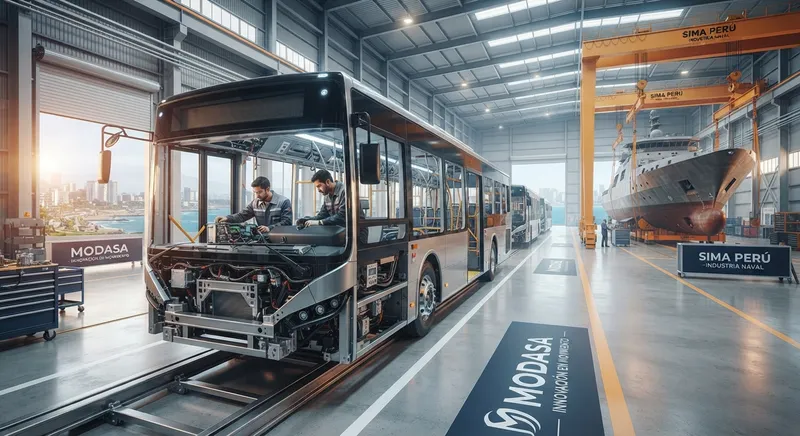
How exports, industrial development, infrastructure and private investment are reshaping Peru. Peru's economy has grown well beyond its traditional base in mining and agriculture. Alongside continued strength in exports, the country has built a genuine industrial sector — from shipbuilding to bus manufacturing to textiles — and is redrawing its logistics map with a new generation of Pacific ports. For international executives, investors and exporters, the picture is one of measured, broad-based growth: solid macroeconomic fundamentals, a widening industrial base, and a substantial pipeline of infrastructure investment at very different stages of completion.
In This Guide
A Steady, Broad-Based Economy
Peru's economy has continued to expand at a moderate but consistent pace. The Central Reserve Bank of Peru (BCRP) raised its 2026 growth forecast to 3.4% in its June Inflation Report, supported by strong private investment — projected to grow at a double-digit rate for a second consecutive year — even as certain commodity sectors have grown more slowly than prices alone would suggest. This growth has been underpinned by one of the region's stronger external positions: in April 2026, Peru's net international reserves surpassed US$100 billion for the first time in the country's history, equivalent to roughly 28% of GDP, according to the BCRP. That buffer gives the country meaningful capacity to absorb external shocks and has been repeatedly cited by analysts as a core pillar of macroeconomic stability.
An Industrial Economy Beyond Commodities
While mining and agro-export remain central to Peru's trade balance, the country's productive base has broadened considerably. Metalworking, transport-equipment manufacturing, textiles and apparel, and shipbuilding have all developed into export-relevant industries in their own right, supported by an extensive network of trade agreements with the United States, the European Union, China and the Pacific Alliance bloc. Peru's Ministry of Production (PRODUCE) has increasingly framed industrial diversification — rather than commodity exports alone — as a strategic priority, and several homegrown manufacturers now compete internationally rather than only supplying the domestic market.
SIMA and Peru's Maritime-Industrial Tradition
Peru's industrial ambitions in shipbuilding are not new. In the mid-19th century, financed by guano-export revenue, Peru acquired one of the first ironclad warships in South America — the Huáscar — and, for a period, fielded what is often regarded as the most important naval force in South America at the time. That maritime-industrial tradition continues today through SIMA (Servicios Industriales de la Marina), Peru's state-owned shipbuilder, which operates the country's principal naval shipyard in Callao.
SIMA and HD Hyundai: A Modern Naval-Industrial Partnership
In recent years, SIMA has entered a significant partnership with South Korea's HD Hyundai Heavy Industries. A defense-export contract signed in April 2024, valued at roughly US$500 million, covers the local construction of a frigate, an offshore patrol vessel and two landing support ships at SIMA's shipyard, with construction underway and deliveries beginning in 2026 — the first of the two landing ships, the Chimbote, has already been launched, with a second, the Talara, completing construction and moving to sea trials in mid-2026. In December 2025, SIMA and HD Hyundai signed a further joint development agreement to co-design a next-generation submarine, with basic design work beginning in 2026 — a project still in its design phase rather than under construction. A broader memorandum between Peru's Ministry of Labor and HD Hyundai outlines an eventual program of up to 23 vessels and includes a technical training component for Peruvian shipyard workers, reflecting a technology-transfer dimension alongside the shipbuilding contracts themselves.
MODASA: Homegrown Manufacturing, Global Reach
In transport manufacturing, MODASA (Motores Diesel Andinos), based in Lima, has become one of Peru's more internationally visible industrial exporters. The company produces buses and power-generation equipment, and in 2020 built Peru's first fully domestically manufactured electric bus. MODASA now exports to more than 25 countries, including the United States, and ranked second among Peru's metalworking-sector exporters in 2024, according to figures from Peru's exporters' association (ADEX), with the company reporting consolidated growth of around 12% that year.
Gamarra: A National Textile and Apparel Hub
Peru's textile and apparel industry is anchored by Gamarra, a dense commercial and manufacturing district in Lima's La Victoria area. It is Peru's largest textile and apparel manufacturing and retail emporium, encompassing thousands of businesses and, according to Peru's national statistics institute (INEI), providing employment for more than 70,000 people, with a significant share of output destined for export. Gamarra illustrates a broader pattern in Peruvian manufacturing: large-scale, labor-intensive production sitting alongside a formalizing base of larger exporters.
Chancay: A New Logistics Gateway, Already Operating
The clearest example of completed infrastructure reshaping Peru's trade position is the deep-water port at Chancay, roughly 80 km north of Lima. Inaugurated in November 2024 and commercially operational since June 2025, the port is majority-owned by COSCO Shipping Ports and provides Peru's first direct container route to Asia. By its first commercial anniversary in mid-2026, the terminal had moved more than 500,000 TEU and 2.4 million tons of cargo, according to operator data — early but concrete evidence of a functioning, not merely planned, gateway. See our dedicated guide to the Port of Chancay for more detail.
Corío and Puerto Eten: The Next Wave of Port Projects
Beyond Chancay, Peru's port-development pipeline includes two further projects at very different stages of maturity. Puerto Eten, in the northern Lambayeque region, is a proposed multipurpose terminal with an estimated private investment in the range of US$500–600 million; as of 2026 it has an approved master plan and preliminary technical viability, with several agro-export, mining and import-sector companies having signed non-binding commitments to use the terminal once built — but land-titling and permitting were still in progress, meaning the project remains in a planning and pre-construction phase rather than under construction. Puerto Corío, proposed for the southern Arequipa region, is a considerably larger and older concept — discussed in various forms for more than two decades — envisioned as a multimodal port potentially exceeding Chancay's scale; it remains at a study and exploratory stage, with cost estimates varying widely across sources and no confirmed construction timeline. Together with Chancay, these projects point to a broader national pipeline of port investment extending along the full length of Peru's coastline, at stages ranging from operational to conceptual.
What Is Driving the Investment Wave
Several factors help explain the current pace of private investment in Peru's industrial and logistics base: sustained macroeconomic stability, reflected in record international reserves and a long-standing network of free trade agreements; a resource base that continues to attract capital in mining and agro-export; growing interest from Asian and North American investors in diversifying supply chains through Latin America; and an active public-private partnership pipeline coordinated through PROINVERSIÓN across ports, roads and energy. Workforce-development initiatives tied to specific projects — such as the SIMA–HD Hyundai training program — also suggest an effort to build long-term domestic capacity rather than rely solely on one-off foreign investment.
Planning to launch, invest, or expand in Peru? The Investment & Business Guide to Peru provides a structured overview of company formation, taxation, market entry, infrastructure, and business opportunities in Lima and the Port of Chancay — designed for foreign founders, executives, and investors.
Explore the Investment & Business Guide to Peru →
Lima Pack — A practical business travel guide to Lima, with selected 5-star hotels, business restaurants, coworking and meeting spaces, transportation tips, and ready-to-use business itineraries. Explore the Lima Pack →
Conclusion
Peru's growth story is no longer only about what comes out of its mines and farms. Between a modernizing shipyard, a globally exporting bus manufacturer, one of the country's largest apparel districts, and a new port already moving cargo to Asia, the country's industrial and logistics base is becoming a more central part of the investment case — even as several of its largest infrastructure projects remain, for now, still on the drawing board.