
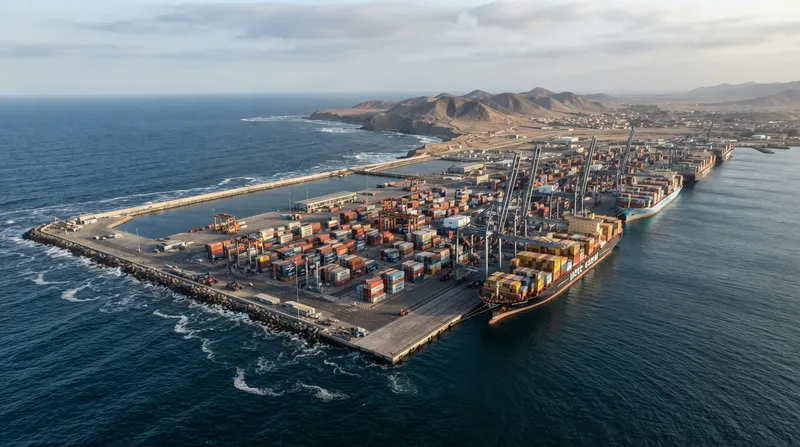
In November 2024, the Port of Chancay opened roughly 80 kilometers north of Lima and became South America's first purpose-built deep-water megaport on the Pacific — reshaping how goods move between the region and Asia. Operated by COSCO Shipping Ports Chancay Peru, it has already pulled logistics companies, exporters and investors north of the capital for meetings that didn't exist on a Peru itinerary a few years ago. This guide covers what the port is, why it matters, and what companies and business travelers should understand before their next trip.
In This Guide
- Port of Chancay: Overview
- Why It Matters for Peru and South American Trade
- The Chancay–Lima Connection
- Logistics and Infrastructure
- Trade Routes and Regional Connectivity
- Business Sectors and Opportunities
- Peru–China Trade Context
- Chancay Park & the Ancón Dry Port
- The Peru–Brazil Bioceanic Corridor
- Peru's Trade Agreements
- What Companies Should Understand
- Practical Business Considerations
- FAQ
Port of Chancay: Overview
The Port of Chancay (Puerto de Chancay) is a multipurpose deep-water megaport in the coastal town of Chancay, in Peru's Huaral province, about 80 kilometers (50 miles) north of Lima. Construction began in 2018, and the port was formally inaugurated on November 14, 2024, in a ceremony held alongside that week's APEC Economic Leaders' Meeting in Lima, marked by Chinese President Xi Jinping and then-Peruvian President Dina Boluarte. After a trial period, it moved to full commercial operations in June 2025.
Chancay is majority-owned and operated by COSCO Shipping Ports Chancay Perú S.A. (CSPCP), a joint venture roughly 60% owned by China COSCO Shipping — China's largest state-owned shipping company — with the remainder held by Peruvian mining company Volcan. Reported first-phase investment is approximately $1.3 billion, with total project cost estimates, including future expansion, cited as high as $3.5 billion. Chancay is one of the highest-profile Belt and Road Initiative projects in Latin America.
The port operates four berths along a 1,500-meter quay — two for containers, two multipurpose — with a maximum depth of 17.8 meters, deep enough for some of the largest container ships afloat, in the 18,000–24,000 TEU range. Designed throughput is 1 million TEU annually near-term, plus capacity for roughly 6 million tons of bulk cargo and up to 160,000 vehicles a year, with plans to scale higher as later phases are completed.
Why It Matters for Peru and South American Trade
For decades, cargo moving between Peru — and much of the Pacific coast of South America — and Asia had to sail via lengthy transshipment through ports in Mexico or the United States, or through the Panama Canal, typically taking 35 to 45 days door-to-door. Chancay's direct-call routes to Shanghai and other Asian ports cut that to roughly 23–25 days, and officials and shipping lines have cited logistics cost reductions of around 20 percent as a result.
That matters beyond shipping statistics. A shorter, more predictable transit time changes the calculation for exporters of perishable goods — Peru's avocado and blueberry sectors chief among them — and for importers bringing finished goods, machinery and vehicles into the region. It also matters geopolitically: Chancay is the first port of this scale on the South American Pacific coast built and operated by a Chinese state enterprise, drawing public comment from U.S. officials concerned about strategic access to the facility.
For Peru specifically, Chancay reflects a bet on becoming a regional logistics hub rather than simply a cargo origin or destination — trade officials have described the ambition as positioning Peru as a Pacific gateway for neighboring economies. Realizing that ambition will depend on continued road and rail investment, sustained shipping-line commitment, and how the port's regulatory environment evolves.
The Chancay–Lima Connection
Chancay's usefulness depends heavily on how well it connects to Lima, and the physical link is more direct than the port's location might suggest. An approximately 1.8-kilometer road tunnel — built beneath the town of Chancay, in the area known as Peralvillo, and engineered with support from the French firm SYSTRA — connects the port directly to the North Pan-American Highway (Peru's Highway 1), the country's principal north–south artery, routing truck traffic around rather than through the town's streets.
By road, the drive between Lima and Chancay typically takes one-and-a-half to two hours each way depending on traffic, making a site visit a realistic single-day round trip from a Lima hotel base — a pattern also reflected in our companion guide to Business Travel in Peru. There is no passenger rail or scheduled transit link for business travelers; visits are made by private car, hired driver, or an arranged transfer coordinated with a host, since the port is a working industrial facility rather than a public visitor site.
Longer term, Chinese and Brazilian officials have discussed the feasibility of a much larger cross-continental rail corridor — the proposed Bioceanic Railway Corridor — that would eventually link Chancay on the Pacific to Brazil's Atlantic coast. As of mid-2026, that corridor remains in a feasibility-study phase rather than under construction, and businesses should treat it as a long-term possibility, not a near-term transport option.
Visiting Lima to see Chancay or meet partners? The Lima Business Travel Pack ($29) helps you plan your stay, transportation, and essential logistics before you arrive.
Get the Lima Business Travel Pack →
Logistics and Infrastructure
Chancay was designed as a "smart and green" port, and its infrastructure reflects that: cargo handling is highly automated, the port runs a fleet of electric container trucks said to cut yard energy consumption by more than a quarter versus diesel equivalents, and entry uses facial-recognition systems alongside 5G connectivity supplied by Huawei to speed truck processing at the gate.
The site has three functional zones: the marine terminal, where the four berths and container yards sit; a logistics and warehousing area for storage, consolidation and value-added services; and the access tunnel connecting to the highway network. For companies planning freight through Chancay, cargo handling, bonded warehousing and inland transport arrangements are increasingly available on-site — though Callao, Lima's historic main port, remains Peru's largest container gateway by volume and stays central to imports serving metropolitan Lima directly.
Operationally, Chancay has scaled quickly: in the first half of 2026 the port handled roughly 200,000 TEU, up about 71% year-on-year, plus close to a million tons of bulk and general cargo — making it Peru's second-busiest container port by volume, behind Callao, with roughly a tenth of the country's total container movement. Around 45% of that volume is transshipment cargo passing through rather than originating or terminating in Peru, underscoring the port's role as a regional hub as much as a national gateway.
Trade Routes and Regional Connectivity
Chancay's core value proposition is route consolidation: rather than shipping lines calling at multiple Latin American ports before crossing the Pacific, Chancay aggregates cargo from a wider catchment and offers direct trunk services to Asia. As of mid-2026, the port operated three trans-Pacific trunk-line services alongside five regional feeder routes along South America's west coast, including a feeder service linking Chancay with the Peruvian port of Paita and with Caldera, Costa Rica.
| Route Pattern | Approx. Transit to Shanghai | Notes |
|---|---|---|
| Traditional route Pre-2024 | 35–45 days | Via Panama Canal or transshipment through Mexican / U.S. ports |
| Direct Chancay–Shanghai service | ~23–25 days | COSCO Shipping trans-Pacific trunk route |
| Regional feeder via Chancay | Varies by origin | Cargo from Chile, Ecuador, Colombia and Costa Rica consolidated before the trans-Pacific leg |
Transit times and cost savings are figures reported by port operators, shipping lines and Peruvian officials; actual transit time varies by vessel, routing and season.
That feeder network is central to Chancay's regional ambitions. Smaller vessels redistribute cargo arriving at Chancay to and from ports in Chile, Ecuador and Colombia, positioning it as a consolidation point for Pacific-facing trade across several countries rather than Peru alone. For Atlantic-facing exporters further afield — Bolivia, Paraguay and particularly Brazil's interior — officials on both sides have promoted Chancay as a shorter alternative to routing exports via the Panama Canal, though realizing that potential depends on infrastructure, like the proposed bioceanic rail corridor, that does not yet exist.
Keeping the comparison honest: Brazil's Port of Santos remains Latin America's busiest container port by a wide margin, followed by Manzanillo in Mexico and Cartagena in Colombia; Peru's own Port of Callao also outranks Chancay on total volume. Chancay's advantage today is not raw throughput — it is a fast-scaling, purpose-built direct-to-Asia route and emerging transshipment hub, rather than the region's highest-volume port.
Business Sectors and Opportunities
Several sectors are already visibly organizing around Chancay, based on the cargo mix and investment reported to date:
Logistics & Freight Forwarding
Customs brokerage, bonded warehousing and inland transport providers are expanding operations to serve cargo moving through the port, particularly as its transshipment role grows.
Automotive Import & Distribution
Chancay's vehicle-handling capacity (up to 160,000 units a year) and COSCO's own projection of roughly 19,000 Chinese-made vehicles moving through the terminal in 2026 reflect a fast-growing channel for automakers expanding into Peru and neighboring markets.
Agro-Export & Cold Chain
Peru's blueberry, avocado and other perishable agro-export sectors stand to benefit from shorter, more predictable transit times to Asian buyers — a factor exporters and logistics planners have pointed to since the port opened.
Peru's mining sector, particularly copper, has also been cited by officials and analysts as a category expected to gain from Chancay's Asia-facing capacity, though the largest share of current activity remains general containerized trade and transshipment rather than mining-specific bulk flows. Companies should treat Chancay as an emerging rather than fully mature channel — volumes are growing quickly, but the port is still ramping toward its design capacity.
Peru–China Trade Context
Chancay cannot be separated from the broader Peru–China commercial relationship. China has been Peru's largest single trading partner for over a decade, importing copper, other minerals, fishmeal and agricultural products while exporting manufactured goods, machinery, electronics and, increasingly, vehicles. Chancay is explicitly framed by both governments as part of China's Belt and Road Initiative, and its financing included a loan package from a consortium of Chinese state banks.
That framing has made Chancay a point of geopolitical interest too. After a multi-year dispute over whether COSCO's concession implied exclusive rights to run all port services at Chancay, Peru's Congress clarified the ports regulator's authority in mid-2024, and in July 2026 a Peruvian court ruled that regulator, Ositran, retains oversight over the privately built terminal as a public-use port — a decision COSCO has appealed. U.S. officials have separately voiced concern about Chinese control of a deep-water Pacific port, drawing parallels to disputes over the Panama Canal. For business travelers, the takeaway isn't that this dimension will disappear, but that it runs alongside — not in place of — ordinary commercial activity: cargo keeps moving even as the port's regulatory status is worked out in Peruvian courts.
Chancay Park and the Ancón Dry Port
The port is the most visible piece of the Chancay story, but it was always meant to sit inside a larger industrial cluster. Two sizeable logistics-and-industrial parks are taking shape on Lima's northern edge, and together with the port they form what Peruvian officials call the Nodo Portuario-Industrial de Chancay — a combined port-and-industrial node.
Chancay Park
A planned 842-hectare logistics and industrial complex immediately adjacent to the port, developed by Roquel Global, a subsidiary of Volcan — the Peruvian mining company that also holds a minority stake in the port itself. The plan envisions logistics, industrial, services-and-technology and residential zones, with an initial-phase investment reported at roughly $248 million and a longer-term projection of around 20,000 direct jobs once fully built. As of 2026, the project has been advancing through environmental-permitting and drilling-authorization stages rather than large-scale construction — real and moving forward, but still some years from completion.
Parque Industrial de Ancón (PIA)
A separate, larger megaproject covering more than 1,300 hectares, positioned by Peru's state investment-promotion agency, ProInversión, as the country's first "dry port" — an inland logistics and customs platform linked to Jorge Chávez International Airport and to both the Callao and Chancay ports. In December 2025, ProInversión awarded the project to the Consorcio Junefield Ancón Industrial Park, formed by Chinese firms Junefield Holdings Limited and Loudi Engineering & Construction; the investment contract, reported at roughly $1.2 billion, was formally signed in March 2026 under a 22-year concession. Officials project space for more than 230 companies and up to 120,000 jobs once fully developed — though, as with Chancay Park, most of that activity is still ahead: 2026 milestones covered the land payment, contract signature and the start of technical studies, not completed construction.
Because Chancay draws frequent comparison to China's Belt and Road Initiative, it is worth being precise about which nearby projects are confirmed and operating, which are officially contracted but still early-stage, and which remain proposals under study. The table below summarizes where each stood as of late 2026.
| Project | Status | Notes |
|---|---|---|
| Port of Chancay Confirmed | Operating | Inaugurated November 2024; full commercial operations since June 2025 |
| Parque Industrial de Ancón | Confirmed / contracted | Awarded and contract signed with the Junefield-led consortium; technical studies and phased construction underway |
| Chancay Park | Announced / in permitting | Environmental and drilling permits advancing; construction-license process ongoing; no confirmed completion date |
| Peru–Brazil Bioceanic Railway Corridor | Proposed / feasibility study | Discussed by Peruvian, Brazilian and Chinese officials; not under construction |
Status summary based on public statements from ProInversión, Peru's Ministry of Production and project developers as reported in 2025–2026; timelines are subject to change and should be independently verified before any business decision.
For business travelers, the practical takeaway is similar for both parks: neither is yet a place to simply show up and tour. Both are being developed in phases, and near-term business activity centers on land preparation, permitting, engineering studies and — increasingly — pre-leasing conversations with logistics operators and manufacturers, rather than finished, occupied facilities.
The Peru–Brazil Bioceanic Corridor
The longest-range piece of the Chancay story is a proposed multimodal route that would eventually connect the Pacific coast to Brazil's interior and, from there, to Atlantic-facing export routes — cutting out the long sail around South America or through the Panama Canal for cargo moving between Asia and Brazil's agricultural heartland.
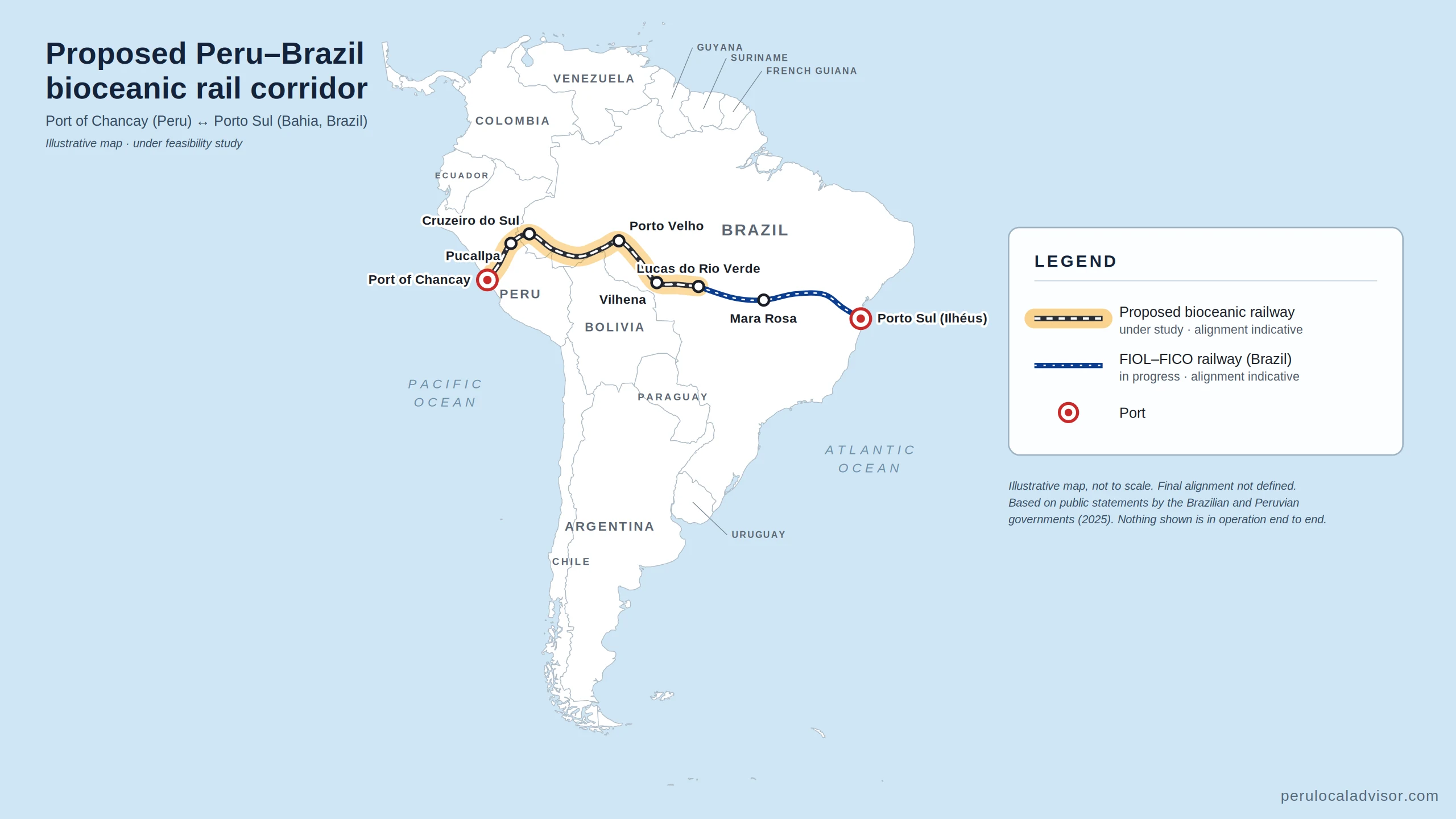
Illustrative map of the proposed Peru–Brazil bioceanic rail corridor, which would link the Port of Chancay with Porto Sul (Ilhéus, Bahia) via Pucallpa, Cruzeiro do Sul, Porto Velho and Lucas do Rio Verde. The alignment is indicative and not final. The Brazilian FIOL and FICO sections are in progress, while the international link remains a proposal under feasibility study — not under construction or in operation.
As discussed by Peruvian and Brazilian officials — with technical and financing interest from Chinese state entities also part of the conversation — the corridor concept links Pacific-side points in northern Peru, including Chancay and the port of Bayóvar, with Brazilian points such as Cruzeiro do Sul, Porto Velho and Rio Branco, continuing toward Brazil's agricultural interior near Vilhena and Lucas do Rio Verde. The route under discussion would combine road, river and rail segments — hence "multimodal" — rather than a single continuous railway.
It is important to be precise about the corridor's current status: as of 2026, it remains a proposed route under feasibility study. No construction has begun, no final alignment has been confirmed, and cost estimates vary widely across sources depending on assumptions about tunneling through the Andes and the exact route chosen. Businesses evaluating Chancay-linked logistics should treat the corridor as a long-term possibility worth monitoring — not as current transport infrastructure to plan around.
Peru's Trade Agreements and Chancay's Role in International Trade
Chancay does not operate in a vacuum — its usefulness depends heavily on the network of trade agreements that shape what can move through it on preferential terms. Peru has built one of South America's more extensive free-trade networks over the past two decades, and several of those agreements connect directly to Chancay's role as a trade gateway.
Peru–China FTA
In force since 2010 and substantially upgraded via a protocol signed in Lima in November 2024, alongside the port's inauguration. The upgrade adds chapters on e-commerce, competition, global supply chains and the environment; China is Peru's largest single trading partner.
CPTPP
Peru has belonged to the Comprehensive and Progressive Agreement for Trans-Pacific Partnership since September 2021, linking it preferentially with 11 other Pacific-facing economies, several with growing trade ties through Chancay's feeder network.
Peru–US & Peru–EU FTAs
Longer-standing agreements with the United States (in force since 2009) and the European Union (in force since 2013) remain central to Peru's trade profile, alongside agreements with EFTA members Switzerland, Norway, Iceland and Liechtenstein.
Peru is also a founding member of the Pacific Alliance alongside Chile, Colombia and Mexico — a bloc built around trade and investment integration among Pacific-facing Latin American economies, a natural complement to a port explicitly designed as a regional consolidation point. Negotiations with additional partners, including India and Indonesia, have continued in parallel, part of a broader Peruvian strategy — one trade officials have explicitly tied to Chancay — of positioning the country as a logistics and trade hub rather than solely an exporter of raw commodities.
For companies evaluating Chancay-routed trade, the practical implication is that tariff treatment depends heavily on origin, destination and the applicable agreement — the same shipment can face very different costs depending on which of Peru's trade agreements applies. This is a matter for customs counsel and trade-compliance specialists rather than a general guide, but it underscores why due diligence on Chancay opportunities should include a look at Peru's trade-agreement landscape, not just port logistics.
What International Companies and Business Travelers Should Understand
Access Is Arranged, Not Casual
Chancay's port facilities are a secure, working industrial site, not a public attraction. Any visit for due diligence, a supplier audit or a site tour needs to be coordinated in advance with a host, the operator, or a local logistics partner.
It Complements Callao, Not Replaces It
Callao remains Peru's largest container gateway and is likely to stay central to cargo destined for metropolitan Lima. Chancay's edge is speed to Asia and a growing transshipment role, not sheer volume — yet.
The Regulatory Picture Is Still Moving
With Peruvian courts, the ports regulator and COSCO in active dispute over oversight as of mid-2026, companies with meaningful exposure to Chancay-routed cargo should track regulatory developments rather than assume today's environment is static.
Practical Business Considerations
Plan the visit as a day trip from Lima. There is no need to relocate a hotel base to Chancay for a single meeting or site visit — the roughly 80-kilometer, 1.5–2 hour drive each way makes it a manageable round trip from San Isidro or Miraflores, Lima's primary business districts. See our guide to business hotels in Lima for where to base yourself.
Confirm connectivity needs in advance. While the port itself runs on modern 5G infrastructure for its own operations, general mobile connectivity in and around the town of Chancay can be less consistent than in central Lima — worth checking with your host if your visit involves real-time data needs. See our guide on internet and eSIM in Peru.
Build in buffer time for site access procedures. The port's facial-recognition entry system and security protocols mean visitor processing takes longer than a typical office check-in; confirm required documentation — passport, company letter, visit authorization — with your host well before arrival.
Treat the port as one stop within a wider logistics conversation, not a standalone destination. Most business visits to Chancay are part of a broader Peru itinerary that also includes meetings in Lima, where the commercial relationships and decision-making around Chancay-routed cargo are still largely managed. Given the port's political profile, it's also worth a quick check of recent Peruvian and international coverage before any trip organized specifically around Chancay-related business.
Planning to launch, invest, or expand in Peru? The Investment & Business Guide to Peru provides a structured overview of company formation, taxation, market entry, infrastructure, and business opportunities in Lima and the Port of Chancay — designed for foreign founders, executives, and investors.
Explore the Investment & Business Guide to Peru →
Lima Pack — A practical business travel guide to Lima, with selected 5-star hotels, business restaurants, coworking and meeting spaces, transportation tips, and ready-to-use business itineraries. Explore the Lima Pack →
❓ Frequently Asked Questions
Conclusion
The Port of Chancay is no longer a construction project to watch from a distance — it is an operating, fast-scaling piece of infrastructure already reshaping trade between the Pacific coast of South America and Asia, and pulling business travel north of Lima. For companies in logistics, agro-export, automotive distribution and mining-adjacent trade, Chancay is increasingly a live consideration. Its scale and evolving regulatory status mean it rewards the same discipline any serious trade opportunity does: verify current facts, arrange site access properly, and treat it as part of a broader Lima-anchored trip. For the wider trip — hotels, etiquette, connectivity and more — see our complete guide to Business Travel in Peru.