A practical guide to bilateral and international business chambers connecting companies, investors and executives in Peru.
Business in Peru runs on relationships as much as on contracts. For an executive, investor or company entering or developing business in the country, a bilateral chamber of commerce can be a practical way to reach people, information and events in Lima without starting from zero. This guide explains what these chambers are, presents a selection of those operating in Peru, and shows how to fit them into a business trip.
In This Guide
Why Chambers of Commerce Matter in Peru
Bilateral chambers are private, member-based organizations that link Peru with a partner country's business community. The chambers covered here describe themselves as non-profit or private institutions, and most count both foreign and Peruvian companies among their members.
For a visitor, that mix is the value. A chamber can be a door to your own country's business community in Peru and to Peruvian companies that already work with your market. It is not a substitute for legal, tax or regulatory advice, and it does not guarantee introductions: memberships, services and events differ from one chamber to another.
Bilateral and International Chambers
The selection below includes chambers whose official websites describe their role in Peru. It is listed alphabetically by partner country, it is not a ranking, and it is not exhaustive. Other bilateral chambers operate in Peru, and several list the Asociación de Cámaras de Comercio Binacionales (ACCB), an association of binational chambers, as an affiliation.
| Partner country | Chamber | What its official website describes |
|---|---|---|
| China | Cámara de Comercio Peruano China (CAPECHI) | A private institution encouraging trade between Peru and China, assisting companies from both countries in promoting business and advising importers and exporters. |
| France | Cámara de Comercio e Industria Peruano Francesa (CCIPF) | A non-profit association of French and Peruvian companies, part of the CCI France International network, with market and prospecting studies, events and member committees. |
| Germany | Cámara de Comercio e Industria Peruano-Alemana (AHK Peru) | A non-profit association and official representative of German industry in Peru, working in areas such as mining, innovation and technology, trade fairs and dual training. Its DEinternational brand is the first contact for German companies planning to enter the Peruvian market. |
| Italy | Cámara de Comercio Italiana del Perú | A non-profit association of Italian and local businesspeople that supports Italian and Peruvian companies, organizes missions and fairs in both countries, and hosts corporate and social events. |
| Japan | Cámara de Comercio e Industria Peruano Japonesa (CCIPJ) | A non-profit association of Japanese companies in Peru, local companies, public entities and individuals linked to Japan, aiming to improve the business environment for investment and trade. |
| Switzerland | Cámara de Comercio Suiza en el Perú (SwissCham Peru) | A non-profit organization promoting investment and trade between Peru and Switzerland, with a role connecting members to contacts in both countries. |
| United Kingdom | Cámara de Comercio Peruano Británica (BritCham Peru) | A non-profit organization promoting commercial and cultural relations between Peru and the United Kingdom, with networking and events. Membership requires an application reviewed by its board. |
| United States | Cámara de Comercio Americana del Perú (AmCham Peru) | An independent non-profit organization connecting Peruvian, US and other companies, with thematic and sector committees, forums, seminars and a program for visiting business and university delegations. |
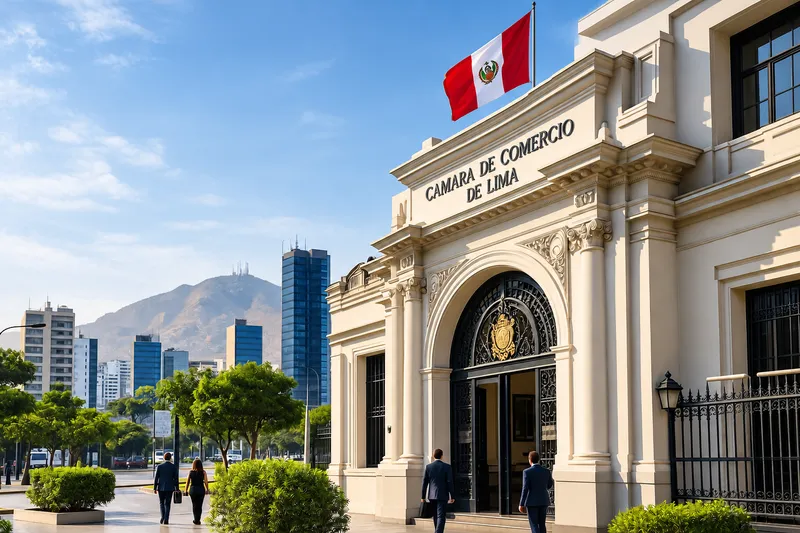
For Peruvian domestic business contacts, the Cámara de Comercio de Lima (CCL) is a different kind of body: a Peruvian private trade association rather than a bilateral chamber, which describes itself as a link between the private sector, the State and international markets.
What Business Travelers Can Use Chambers For
Chambers describe their work in broadly similar terms. Depending on the chamber, a business traveler can look to it for:
- Market entry orientation. AHK Peru's DEinternational brand targets German companies entering Peru, and CCIPF describes support with prospecting and contact with local actors.
- Introductions and networking. Events, committees and member directories. Some directories are restricted to members, so access rules vary.
- Market information. Newsletters, publications and committee discussions on sectors and regulation.
- Trade fairs and delegations. The Italian chamber organizes missions and fairs, AHK Peru lists trade exchange and fairs among its focus areas, and AmCham Peru runs a program for visiting delegations.
- Local business contacts. CCIPF describes identifying commercial partners and organizing business meetings as part of its company support services.
Many services are aimed at members. Before travelling, ask each chamber what is open to non-members and which services carry a fee.
Chambers, Business Events and Networking
Chambers organize part of Lima's business events calendar. Their websites describe forums, seminars, workshops, conferences, working breakfasts and after-office gatherings. The Italian chamber, for example, lists conferences, talks and working breakfasts alongside social events. Some chamber events have been held at Lima hotels and convention venues.
Check each chamber's official calendar before you travel and confirm whether non-members can register, plus the language, time and format. For trade fairs and larger conferences beyond the chamber circuit, see our guide to Trade Fairs & Business Events in Peru.
Chambers and Different International Business Networks
Each bilateral chamber is organized around its own home-market community. A German company will naturally start with AHK Peru, a US company with AmCham Peru, a Japanese company with CCIPJ, and so on.
Chambers are not only for foreign nationals, though. Most include Peruvian companies and professionals among their members, so they also lead to local counterparts who already work with your market. Executives with interests in more than one market may find more than one chamber relevant, and several chambers share the ACCB affiliation.
Preparing for a Chamber Meeting
- Define your goal: market information, a specific introduction, an event, or a delegation program.
- Choose the chamber that matches your home market or your target counterparts.
- Read the official website first: services, membership terms and event calendar.
- Contact the chamber in advance through its official channels with a short, specific request, and ask what is available to non-members.
- Confirm the practicalities: date, address, language and whether the meeting is in person or online.
- Bring materials in Spanish and English, plus business cards.
- Follow up in writing after the meeting or event.
Chambers and the Lima Business Travel Itinerary
Several of these chambers list offices in San Isidro, Miraflores or Jesús María, and San Isidro and Miraflores are also where many business travelers base themselves (see Business Travel in Peru). Confirm the exact address and entry procedures before each visit, since events may take place at hotels or other venues.
Group chamber meetings with other appointments in the same area and allow buffer time for Lima traffic. Consider placing a chamber event early in the trip, when introductions can still lead to follow-up meetings during the same visit.
Planning to launch, invest, or expand in Peru? The Investment & Business Guide to Peru provides a structured overview of company formation, taxation, market entry, infrastructure, and business opportunities in Lima and the Port of Chancay — designed for foreign founders, executives, and investors.
Explore the Investment & Business Guide to Peru →
Practical Takeaway
A bilateral chamber is a low-friction starting point for business contacts in Peru, not a shortcut around due diligence. Choose one or two chambers that match your market, check current services and events on their official websites, contact them before you travel, and keep legal, tax and regulatory questions with qualified advisers.
Services, membership terms and event calendars change, so always confirm details with the chamber directly.