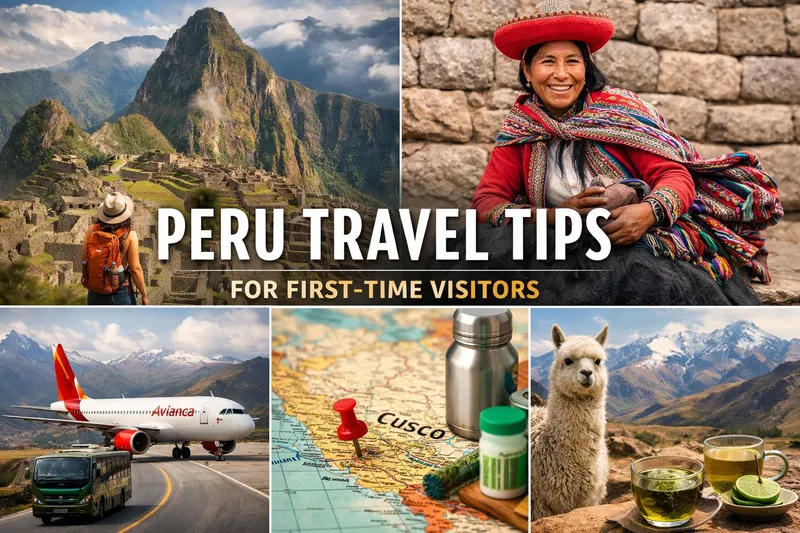
Visiting Peru for the first time can feel overwhelming — diverse climates, living cultures, and extreme landscapes all at once. But preparation is the key to enjoying it all. Here's what every first-time traveler should know before arriving.
Peru spans three dramatically different geographic zones — the coastal desert, the Andean highlands, and the Amazon rainforest — each with its own climate, culture, and logistics. Most first-time visitors follow a route that touches all three: a few days in Lima, a flight up to Cusco for the Sacred Valley and Machu Picchu, and sometimes a side trip to the coast or jungle. This guide covers the essentials — transport, entry requirements, timing, climate, culture, health, connectivity and money — so you can focus on the experience, not the logistics.
If you're still deciding how many days to spend and where, it's worth reading our guide on planning a 7, 10 or 14-day Peru itinerary before you book flights — the route you choose will shape almost every decision below.
🚖 Transport: Getting Around Peru
How to Move Between Cities
Flights · Buses · Taxis · Apps
Domestic flights save significant time between major cities. Lima → Cusco (1 hr vs 22 hrs by bus) is the most common route, followed by Lima → Arequipa and Cusco → Puerto Maldonado for the Amazon. Airlines like LATAM, Sky, and Avianca Peru operate reliable domestic connections, and prices are usually reasonable if booked a few weeks ahead.
Buses are budget-friendly and cover routes that flights don't reach. For overnight journeys, choose premium bus companies: Cruz del Sur and Oltursa offer cama (fully reclining) seats, onboard security, and GPS tracking. Avoid unbranded or discount operators on long routes, especially at night.
Trains to Machu Picchu run on separate rail lines operated by PeruRail and IncaRail, connecting Cusco or Ollantaytambo to Aguas Calientes. Seats sell out weeks in advance in high season, so book early — our complete guide to reaching Machu Picchu breaks down every route and ticket option.
In Lima, always use InDriver, Uber, or official airport taxis — never hail a street taxi at night. In Cusco, mototaxis are common but negotiate the price before getting in. If you're unsure which neighborhoods to base yourself in, see our guide on Miraflores vs Barranco and our list of Lima neighborhoods to avoid.
Tip: Download InDriver before arriving — it works offline for booking and is widely used across Peru.
🛂 Entry Requirements: Visa, Passport & Vaccines
What You Need Before You Fly
Visa · Passport Validity · Insurance · Vaccines
Citizens of the United States, Canada, the European Union, the United Kingdom, and most Latin American countries do not need a visa for tourist stays of up to 90 days — a passport valid for at least six months beyond your travel dates is generally required at immigration. Always check current requirements for your specific nationality before booking, since entry rules can change.
Travel insurance is strongly recommended, ideally a policy that covers high-altitude emergencies and medical evacuation, particularly if you're planning to trek near Cusco or Huaraz.
Vaccinations: no vaccines are mandatory for most travelers, but yellow fever vaccination is recommended if you're heading into the Amazon rainforest, and routine vaccines (tetanus, hepatitis A/B, typhoid) are worth discussing with a travel clinic 4–6 weeks before departure.
Tip: Keep a digital and physical copy of your passport, insurance policy, and entry stamp — you may be asked to show your entry date when leaving the country.
🗓️ Best Time to Visit Peru
Choosing Your Travel Dates
Dry Season · Wet Season · Shoulder Months
May to September (dry season) is the classic window for Cusco, the Sacred Valley, and Machu Picchu — clear skies, dry trails, and the best trekking conditions. It's also peak season, so flights, trains, and hotels sell out and prices rise; book several months ahead if traveling in June, July, or August.
October to April (wet season) brings more rain to the highlands, especially January to March, but also fewer crowds, greener landscapes, and lower prices. Machu Picchu stays open year-round except for scheduled maintenance closures, typically in February.
Lima's climate runs on a different calendar — it's mild and dry year-round, with a grey coastal mist (garúa) from May to November and warmer, sunnier weather from December to April, which is actually Lima's best season even though it's the Andes' wet season.
Tip: If your dates are flexible, late April, May, September, and early October offer a good balance of good weather and smaller crowds.
🌦️ Climate: Pack Smart for Three Worlds
Peru's Three Climate Zones
Coast · Andes · Amazon
Lima and the Coast are desert: dry year-round, with a grey sea mist (garúa) from May to November. Temperatures rarely drop below 15°C or rise above 28°C. Light layers and a windbreaker are sufficient.
Cusco and the Andes have a dry season (April–October) and wet season (November–March). Nights at 3,400 m can be cold (5–10°C), even in summer. Pack a warm fleece, waterproof jacket, and UV sun protection — altitude sun is intense.
The Amazon is humid year-round, with temperatures around 25–35°C. Light, breathable clothes, long sleeves for evening mosquitoes, and waterproof bags are essential.
Because a typical first-time itinerary moves between all three zones within a week or two, packing efficiently matters more than packing a lot. For a full checklist organized by climate zone and activity, see our detailed Peru packing list.
Tip: Even on a single trip, you may pass through all three zones — pack layers, not bulky items.
🤝 Culture: Connecting Respectfully
Understanding Peruvian Culture
Etiquette · Language · Customs
Peruvians are warm and genuinely welcoming to visitors 🤝. A simple greeting in Spanish goes a long way: "Buenos días" (good morning) or "¿Cómo está?" (how are you?) opens doors everywhere. In Andean communities, a few words of Quechua are received with delight.
When visiting markets, especially in the Andes, ask before photographing local people — it's a sign of respect that is deeply appreciated. At archaeological sites, never climb walls, touch carvings, or remove any stones — these are federal offenses in Peru.
Bargaining is acceptable at craft markets but always done with good humor. Paying the asking price is also perfectly fine and directly supports artisan families.
Personal safety is rarely an issue if you take normal precautions — stick to well-traveled areas, keep valuables out of sight, and avoid walking alone late at night in unfamiliar neighborhoods. Our in-depth guide on whether Lima is safe for tourists covers this in more detail, and pairs well with our overview of safe, authentic travel routes across Peru.
Tip: Buy handicrafts directly from artisans rather than intermediaries — the quality is higher and all the money reaches the maker.
💊 Health: Altitude Sickness Is Real
Staying Healthy at High Altitude
Soroche · Hydration · Medical
Altitude sickness (soroche) can affect anyone regardless of age or fitness level. Symptoms include headache, nausea, dizziness, and fatigue. The best prevention is gradual acclimatization — spend at least 2 nights in Cusco (3,400 m) before attempting any high-altitude trek.
Drink coca tea 🍵 — freely available throughout Cusco — which helps the body adapt to altitude. Avoid alcohol and heavy meals for the first 48 hours. Stay well hydrated with bottled water.
Acetazolamide (Diamox) is a prescription medication that speeds acclimatization. Consult your doctor before travel if you have a history of altitude sensitivity.
For general health: drink bottled or filtered water throughout Peru, even in cities. Carry basic medication (anti-diarrheal, pain relief) and travel insurance that covers emergency evacuation. If altitude is your main concern, our dedicated guide on how to avoid altitude sickness in Cusco goes into far more depth on acclimatization schedules and medication.
Tip: Pharmacies (farmacias) in Peru are excellent and over-the-counter medication is widely available and affordable.
📶 Staying Connected: Internet & SIM Cards
Getting Online in Peru
eSIMs · Local SIMs · Wi-Fi Coverage
Mobile coverage in Peru is better than most first-time visitors expect. Claro, Movistar, and Entel all offer solid 4G coverage in Lima, Cusco, Arequipa, and along the main tourist routes; coverage thins out in remote Andean valleys and disappears almost entirely in parts of the Amazon, where many jungle lodges rely on satellite internet instead.
The easiest option for most travelers is an eSIM activated before departure, so you land already connected without hunting for a local SIM card or dealing with roaming charges. A physical SIM from Claro or Movistar is cheaper if you're staying longer, but requires a passport and a visit to a store or airport kiosk. Our full breakdown of how to get internet in Peru compares both options city by city.
Tip: Download offline maps and your bus or train tickets before heading into the Sacred Valley or Amazon, where signal can drop without warning.
💰 Money: Cash Is Still King
Managing Money in Peru
Soles · ATMs · Cards
Peru's currency is the sol (PEN). Cash is essential in rural areas, small restaurants, markets, and transportation. ATMs are widely available in Lima, Cusco, Arequipa, and Puno — but rare in smaller towns and completely absent in rural communities.
Credit cards (Visa most widely accepted) work in most hotels, larger restaurants, and tour agencies, but a surcharge of 3–5% is common. Always have small bills — change for 100-sol notes can be difficult to get at local stalls.
As a rough daily budget guide: backpackers typically spend $35–55/day, mid-range travelers $90–160/day, and travelers prioritizing comfort $220+/day, depending heavily on whether you're booking guided tours or organizing everything independently.
Tip: Withdraw cash in Lima or Cusco before heading to rural areas. Budget roughly 30–50 soles/day for incidentals in the highlands.
🍽️ Bonus Tips: Food, Shopping & Archaeology
Make the Most of Your First Trip
- 🍽️ Try the local food at every stop. Ceviche in Lima is world-class. Cuy (guinea pig) in Cusco is a cultural experience. Juane (rice and chicken in a leaf) in the Amazon. Peru's culinary diversity is astonishing.
- 🪙 Buy handicrafts directly from artisans. Pisac market, Chinchero weavers, and Taquile island textiles are authentic and far superior to Lima airport souvenirs.
- 🏛️ Respect archaeological sites. Don't climb walls, sit on stones, or touch carvings. These sites are thousands of years old and irreplaceable.
- 🌿 Hire a local guide. At Machu Picchu, the Sacred Valley, and even Lima's Larco Museum — a good local guide transforms what you see into what you understand.
- 📱 Get an eSIM before you leave home. Peru's mobile coverage is surprisingly good, but being connected from the moment you land makes everything easier.
- 🏨 Pick your Lima base carefully. Most first-time visitors stay in Miraflores or Barranco for safety, walkability, and easy airport access — see our sidebar picks below or the full Lima hotel guide for options across every price range.
- 🗺️ Don't over-pack your itinerary. Altitude, distances, and single daily entry windows at sites like Machu Picchu mean that fewer stops, done properly, beat a rushed checklist. Our itinerary planning guide can help you pace it right.
📌 Conclusion
Peru rewards those who prepare. Understanding the logistics, respecting the culture, protecting your health at altitude, staying connected, and managing money wisely are the foundations of a great first trip. None of it is complicated once you know what to expect — most first-time travelers who run into trouble in Peru do so because of a skipped acclimatization day, an unplanned cash shortage in a rural town, or an underestimated distance between destinations, not because the country is difficult to navigate.
With Peru Local Advisor, you'll travel prepared, confident, and connected to authentic local experiences that no guidebook can replicate. Use the trip planner and hotel picks in the sidebar to start turning this guide into an actual itinerary, and browse our Travel News section for destination-specific guides once your route starts taking shape.
🚐 Private Airport Transfer in Lima
Many first-time visitors prefer booking a private airport transfer from Lima Airport (Jorge Chávez) to Miraflores or Barranco for extra comfort and safety — especially for late-night arrivals. Fixed price, no negotiating, English-speaking driver.
Book a Lima Airport Transfer →🎟️ Book Your Machu Picchu Experience
Tickets and guided tours often sell out weeks in advance — especially May to October. Book early to secure your spot.
Machu Picchu Full-Day Tour from Cusco
Guided Machu Picchu experience from Cusco with scenic Andean views. Expert local guide, entrance tickets, and round-trip transport included.
Explore Full-Day Tours →2-Day Machu Picchu Train Tour from Cusco
Scenic train journey through the Andes, a guided Machu Picchu experience, and a relaxed 2-day adventure. Ideal for travelers who want to take it all in without rushing.
Explore 2-Day Train Tours →Luxury First-Class Machu Picchu Train Tour
First-class panoramic train with gourmet dining, Andean views, and a fully guided Machu Picchu experience. The premium way to see the Inca citadel.
Explore Luxury Tours →Machu Picchu Train Tour from Cusco
One of Peru's most iconic journeys — scenic train ride through the Andes, entrance tickets included, expert guidance. A complete, stress-free Machu Picchu experience from Cusco.
Explore Machu Picchu Train Tours →Affiliate disclosure: Links above are sponsored partner links. Prices and availability are managed by Klook. Peru Local Advisor may earn a small commission at no extra cost to you.
✈️ Travel Tip: Save on Roaming Costs in Peru
Travelers can avoid expensive roaming fees by using Airalo eSIMs , the world’s first eSIM store with fast, reliable data plans for Peru and 200+ destinations.
Exclusive Offer: Save 15% on your first eSIM with the code PERULOCAL .
Set up your Airalo eSIM before flying and stay connected the moment you land. Buy Your eSIM
Ready to travel smarter? Get Your eSIM Now
Offer valid until December 31, 2026.