
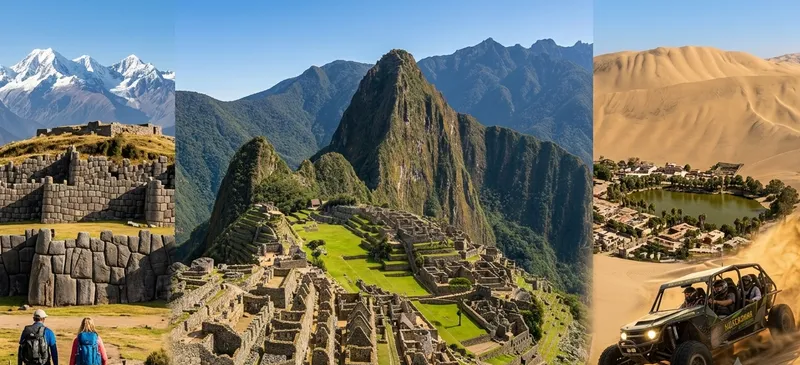
Ten days is the classic window for a first trip to Peru — enough time to see Lima, acclimatise properly in Cusco, walk through Machu Picchu, and stand on the shores of Lake Titicaca, without the trip feeling like a sprint.
This itinerary is built as a practical loop that starts and ends in Lima, follows the natural transport corridors of southern Peru, and respects the altitude changes your body needs time to adjust to. Below you will find the day-by-day plan, recommended transport between each stop, an approximate budget, the best season to travel, and the practical tips that make the difference between a smooth trip and a stressful one.
🗓️ Itinerary Overview
The route runs Lima → Cusco → Sacred Valley → Machu Picchu → Cusco → Puno → Lima, entirely by domestic flight and train/bus combinations. It prioritises the two destinations every first-time visitor wants most — Machu Picchu and Lake Titicaca — while giving Cusco enough days to acclimatise safely before the trek to the Sacred Valley.
This is a proven 10-day route. If you want a tailor-made itinerary, use our free AI Trip Planner.
Day 1: Arrival in Lima
Gateway · Pacific Coast · 0 m altitude
Land in Lima and settle into Miraflores or Barranco, the two safest and most walkable neighbourhoods for visitors. Use the afternoon to stroll the Malecón clifftop path above the Pacific, and reserve the evening for Lima's celebrated food scene — the city is South America's culinary capital, and a simple ceviche lunch or pisco sour at sunset is the right way to start. If your flight lands early, a half-day tour of the historic centre (Plaza Mayor, the Cathedral, and the San Francisco catacombs) fits comfortably into day one.
Tip: Book an airport transfer in advance rather than hailing a taxi at arrivals — it is safer and only marginally more expensive.
Days 2–4: Cusco & the Sacred Valley
Inca Capital · 3,400 m · UNESCO World Heritage
Fly to Cusco (roughly 1h20 from Lima). Day two should be kept deliberately light — rest, drink coca tea, eat lightly, and let your body begin adjusting to the altitude. Day three is ideal for a half-day city tour: the Cathedral, Sacsayhuamán, and Qorikancha, followed by an easy evening in the Plaza de Armas. Day four moves into the Sacred Valley: the Pisac market and ruins, the salt pans of Maras, the agricultural terraces of Moray, and the fortress town of Ollantaytambo, which also serves as the train departure point toward Machu Picchu.
Tip: Buy the Cusco Tourist Ticket (Boleto Turístico) on arrival — it covers 16 sites, including Sacsayhuamán and several Sacred Valley ruins, at one fixed price.
Day 5: Machu Picchu
The Icon · 2,430 m · UNESCO World Heritage
Take the early train from Ollantaytambo to Aguas Calientes (about 1h30), then the shuttle bus up to the citadel (25 minutes). Machu Picchu sits lower than Cusco, so altitude is no longer a concern here — but crowds are. An early entry ticket (6–7am) buys you at least an hour of relative calm before the busiest hours. Budget two to three hours inside with a guide, who will make sense of the agricultural terraces, temples, and residential sectors that would otherwise be just beautiful stonework. Return to Cusco the same evening or stay overnight in Aguas Calientes if your schedule allows.
Tip: Book Machu Picchu entrance tickets and your train at least 4–6 weeks ahead in high season (May–September) — both sell out.
Day 6: Cusco
Rest & Explore · San Blas · Local Markets
Use this day to explore Cusco at a slower pace: the artisan neighbourhood of San Blas, the San Pedro market for local produce and lunch, and any of the museums you skipped earlier (Museo Inka, Museo de Arte Precolombino). This is also a sensible buffer day in case Machu Picchu logistics ran long, and a good moment to shop for alpaca knitwear and other souvenirs before heading south.
Tip: San Pedro market is at its best — and least touristy — before 10am.
Days 7–8: Puno & Lake Titicaca
Altiplano · 3,812 m · World's Highest Navigable Lake
Travel by tourist bus from Cusco to Puno (approximately 7 hours, with worthwhile stops in Raqchi, La Raya Pass, and Pukara). Day seven is for arrival and acclimatisation — Puno sits even higher than Cusco. On day eight, take a boat excursion to the floating Uros Islands, built entirely from reeds, and continue to Taquile Island for a look at its centuries-old weaving traditions and a simple lakeside lunch. Travellers with extra time can extend to an overnight homestay on Amantaní, one of Peru's most genuine cultural experiences.
Tip: Take the tourist bus rather than the direct bus — the extra stops along the route are worth the additional time.
Days 9–10: Return to Lima & Final Recommendations
Pacific Coast · Gastronomy · Departure
Fly from Juliaca (Puno's airport) back to Lima, usually via a short connection. Use day nine for the Larco Museum, a cooking class in Miraflores, or one last outstanding meal — Lima's restaurant scene rewards a final splurge. Day ten is departure day: Jorge Chávez Airport sits in Callao, about 45 minutes from Miraflores in normal traffic, so build in at least two hours of buffer given Lima's unpredictable congestion.
Tip: Keep your last morning flexible — traffic delays of 60–90 minutes to the airport are common, not exceptional.
🚌 Transport Between Destinations
Lima → Cusco: Flight, 1h20 (LATAM, Sky Airline, JetSmart). Cusco → Sacred Valley: Private transfer or shared tourist shuttle, 1–1.5 hours. Ollantaytambo → Aguas Calientes: Train (PeruRail or Inca Rail), 1.5 hours. Cusco → Puno: Tourist bus with scenic stops, 7 hours (or direct bus, 6 hours). Puno/Juliaca → Lima: Flight, typically with one stop, 2.5–4 hours total.
💰 Approximate Budget
Budget traveller: USD 55–75 per day (hostels, local buses, set menus, group tours). Mid-range: USD 110–150 per day (comfortable hotels, some private transfers, guided excursions). Premium: USD 220+ per day (boutique hotels, private guides, first-class trains). Key fixed costs: Machu Picchu entrance (USD 50–60), Cusco Tourist Ticket (USD 40), and the train to Aguas Calientes (USD 50–140 return depending on class).
📅 Best Time to Travel
The dry season (May to October) offers the clearest Andean skies and the most reliable conditions for this itinerary — June to August is peak season, so book Machu Picchu and Cusco accommodation two to three months ahead. The wet season (November to April) brings afternoon rain to the highlands but far fewer crowds and lower prices; January and February are the wettest months, and the Inca Trail partially closes for maintenance in February.
💡 Practical Tips: Altitude, Money, Safety, Bookings & Packing
Altitude: Cusco (3,400 m) and Puno (3,812 m) are the two points where altitude sickness is most likely. Arrive with a light schedule on day one in each, drink coca tea, avoid alcohol for the first 24 hours, and stay well hydrated. Speak to your doctor about acetazolamide (Diamox) if you are prone to AMS.
Money: Carry Peruvian soles for daily expenses — ATMs are reliable in Lima, Cusco, and Puno, but scarce once you leave the main towns. Most hotels and tour operators accept card, but small restaurants and taxis usually do not.
Safety: Peru is generally safe for tourists who take standard urban precautions — use registered taxis or ride-hailing apps, keep valuables out of sight, and avoid walking alone late at night in unfamiliar areas. Cusco and Puno are calm cities, and their main tourist areas are heavily patrolled.
Bookings: Reserve Machu Picchu tickets and trains 4–6 weeks ahead in high season; Cusco hotels should also be booked early during June–August. Lake Titicaca boat tours can usually be arranged a day or two in advance.
Packing: Layer for temperature swings of 20°C+ between day and night in the Andes — a warm jacket, a rain shell, sun protection, and comfortable walking shoes cover most of this route. A reusable water bottle and basic altitude medication are also worth packing.
🔀 Variants for More or Less Time
7 days: Drop Puno and Lake Titicaca; focus entirely on Lima, Cusco, the Sacred Valley, and Machu Picchu. 14 days: Add Paracas, Huacachina, and Arequipa with the Colca Canyon before heading to Cusco — see our 14-day Peru itinerary for the full route. 21 days: Add the coastal south, Arequipa, and an Amazon extension in Puerto Maldonado — see our 21-day full loop.
Create Your Personalized Peru Itinerary
Turn your travel dates, interests and budget into a practical day-by-day Peru itinerary in under 60 seconds. Plan your route across Lima, Cusco, the Sacred Valley, Machu Picchu and beyond, with travel times, an interactive route map and a downloadable PDF. Built around realistic distances and regional travel logistics, your itinerary gives you a clear starting point for planning your trip.
CREATE MY FREE ITINERARY →✈️ Travel Tip: Save on Roaming Costs in Peru
Travelers can avoid expensive roaming fees by using Airalo eSIMs, the world's first eSIM store with fast, reliable data plans for Peru and 200+ destinations.
Exclusive Offer: Save 15% on your first eSIM with the code PERULOCAL.
Set up your Airalo eSIM before flying and stay connected the moment you land. Buy Your eSIM
Ready to travel smarter? Get Your eSIM Now
Offer valid until December 31, 2026.